Showing posts with label Ottoman horse tack. Show all posts

Friday, June 19, 2026

Ottomans archery practice in XVI century - Jost Amman

 Slavete Omnes,


From British Museum, under Creative Commons licence, comes this XVI century print by the German printmaker Jost Amman, who frequently drew and printed images of the Ottoman warriors and soldiers.


It comes from this print, lavishly published by Jost Amman, and the British institution has only this etching. The etching shows some episode from the Ottoman wars in Hungarian Kingdom of the 1520-30s. . 

translation from German - via Google translate 

..

Our Polish painter Jozef Brandt was influenced by the images of such equestrian archery feats


Valete

Friday, November 28, 2025

Mehmed Effendi to Louis XV in period art

 Salvete Omnes,

Embassy with the king's musketeers 


Sultan Achmet/Ahmet III sent his ambassador Mehmed Effendi 


to the French court of king Louis XV in 1720-21AD.


There are several outstanding iconographic sources showing the embassy and ceremonies in Paris in March 1721, with the splendorous attired soldiers and courtiers, their horse tack, horses and ceremonial of the Ottoman embassy. 


.


. The painting by Charles Parrocel , master painter  of equestrian form and beauty, shows the splendors of the Ottoman horsemanship and wonderful horses and their splendid horse tack.


and king's musketeers


enjoy 

Valetet

Friday, July 19, 2024

Turkish Horses - J.G. Pforr

 Salvete Omnes,


it seems to me that we have one lazy Friday of the dog days of this summer, save for the attempted assassination of the former POTUS in Pennsylvania last Saturday, a d here we are continuing with the horses of brushes and pencils by Johann Georg Pforr. 
today we will look at the Turkish horse - or the horse of the Ottoman Empire, the multiethnic and multireligious imperial realm, in the second half of the XVIII century in a serious eclipse, both militarily and economically. 

Two horses, of which the grey is saddled with a type of saddle known as jarczak(Jarcak)

.


.


.


.

details of the legs and hooves
.

Jarczak saddle, with an obergurt (ober-sattelgurt) or ryngort (leather straps with cinch arrangement holding the saddle with a shabraq on horse's back) 


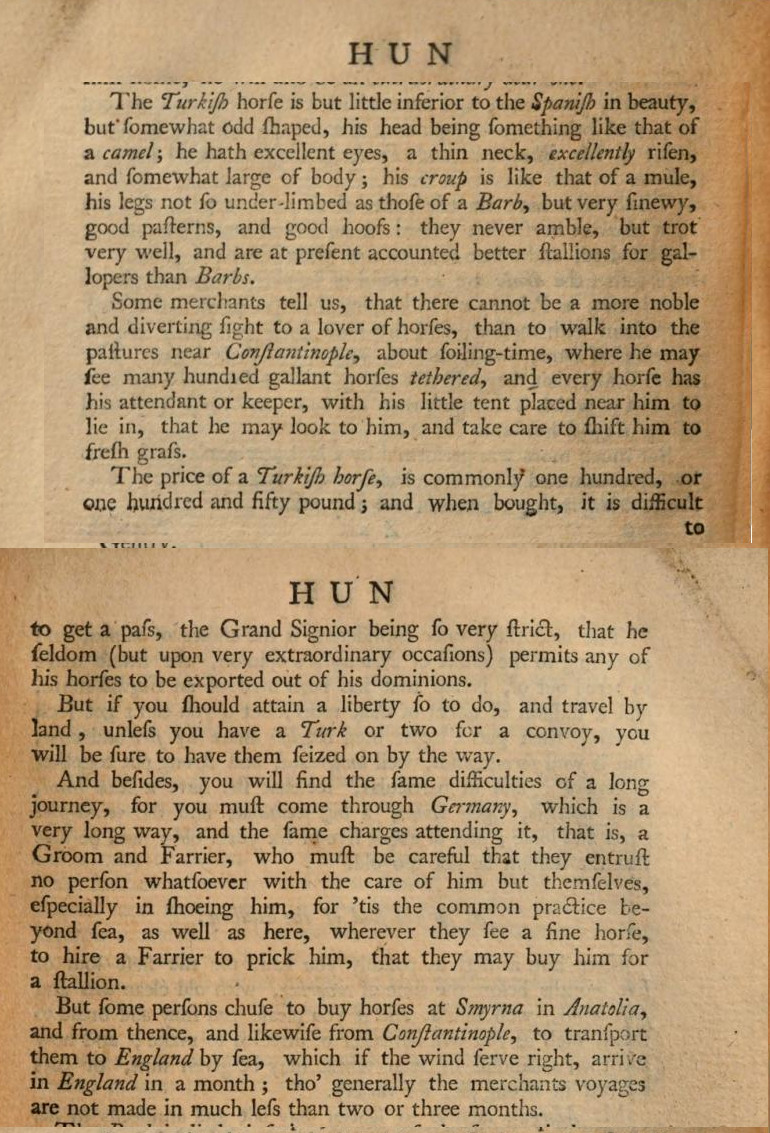
and finally, what our good friend The Sportsman's Dictionary had to say about the Turkish horse circa 1770AD- 


Valete

Wednesday, July 19, 2023

De Warnery on Ottoman Turkish Spahis

 Salvete Omnes,


long time ago I brought here the book by a Prussian & Polish cavalry general Charles de Warnery - Remarks on Cavalry

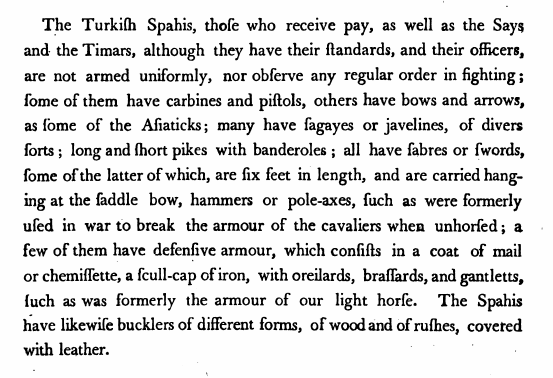
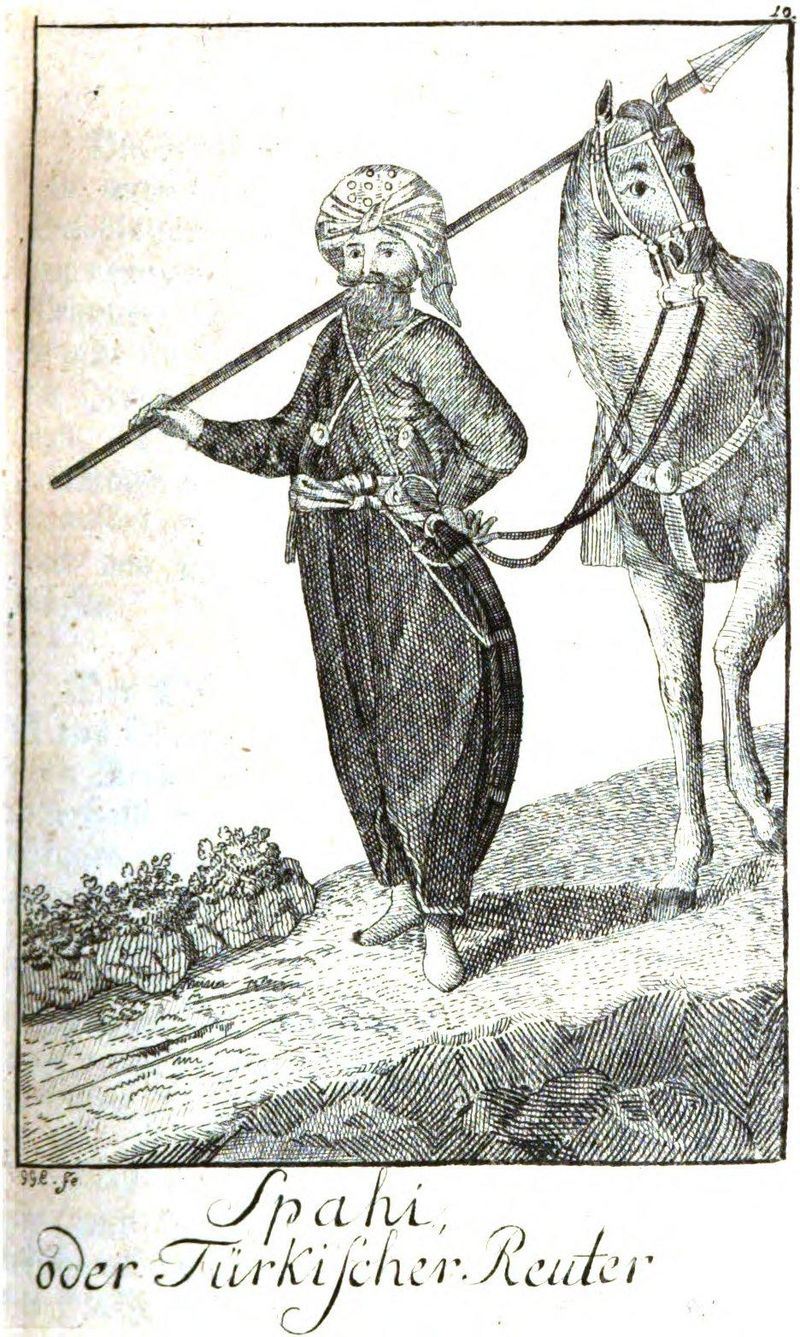
Today, I would like to bring to your attention the short description of the Ottoman Turkish spahis/sipahi as seen by general de Warnery. 


and some other late XVIII century images of the Ottoman Spahis


enjoy

Valete

Tuesday, April 18, 2023

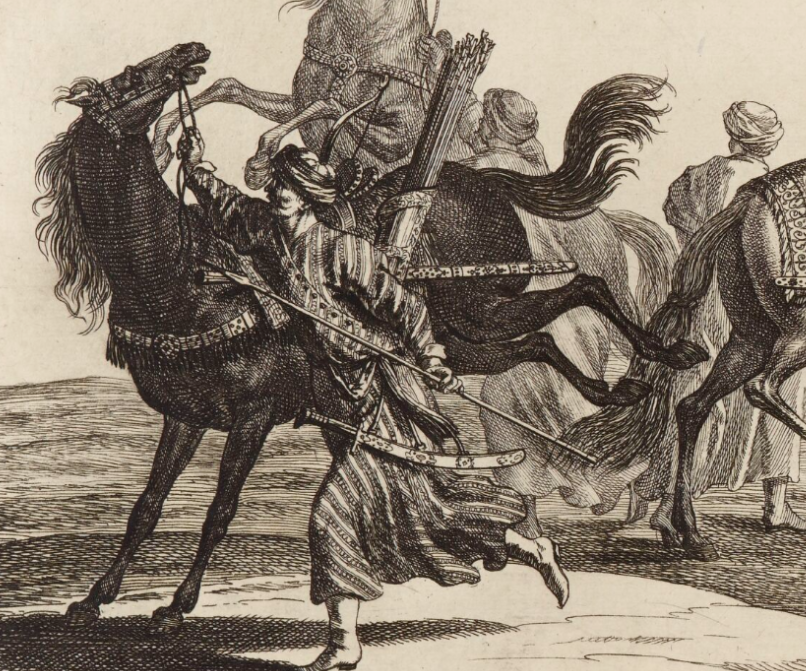
Ottoman aspect of Certamen Equestre - a detail

 Salvete Omnes,

more than 9 years ago i posted the saddle detail from the Certamen Equestre  Ottoman Turkish section- of Gallica French national Library provenance.
in this plate there is an interesting detail , in my opinion, worth looking at -

note the sumptuous saddle coverings and shabraques, dydwyks and bejeweled harnes and kalkan shield, tuck sword etc 


Namely, this part -

In my opinion it looks very much like a type of a Ottoman Trukish cirit or short dzida like in this detail from Querfurt's painting

Valete

Sunday, June 5, 2022

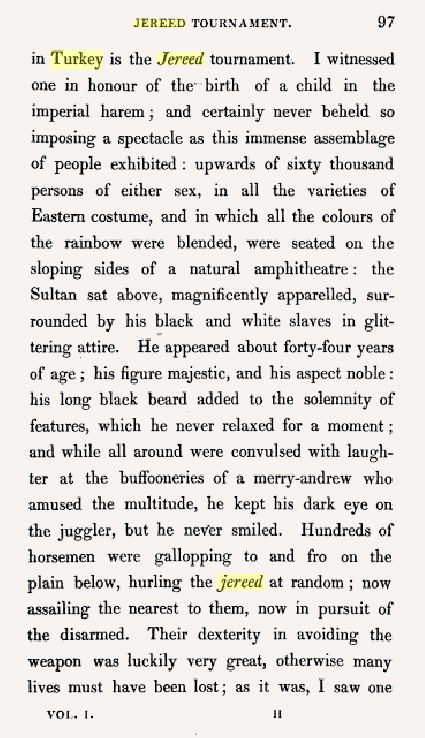
Cirit - Jereed

 Salvete Omnes,

let us gallop with a javelin in hand - Turkish-Persian style.

 First, a note on Cirit aka Jereed from XIX century -
'Jereed is a short lance, having a blunted head, when used in sport, but sharpened for warlike purpose; it is one of the most favorite amusements, both in Persia and Turkey. A good description of exercise will be found in Mr Morrier's 'Ayesha.''

Next, from a traveling-spying book by  a British journalist/useful observer - Richard Robert Madden

Travels in Turkey , Egypt, Nubia and Palestine: 1824, 1825,1826, and 1827.    - this is his depiction: 


and to illustrate this 1820s description a painting by Luigi Acquarone after Antoine Ignace Melling -


Valete

Saturday, January 29, 2022

Winged Hussar and other images from the Book of friends

Salvete Omnes,


Book of friends -  or more properly Johann Joachim Prack von Asch's liber amicorum was a compilation of entries spanning 1587-1612AD, including the period of the so called Long War (thanks to Bruno Mugnai I have the 2-volume book  on the said war  ), with the paper coming from the ancient paper bazar in Constantinople. Joachim Prack von Asch from was a Hapsburg diplomat, who  traveled between Constantinople,  the capital of  Ottoman Empire and  Bohemia and other lands of his emperor, Rudolph II Hapsburg.

The Book of Friends is available either on the Getty Digital Collections site or on Archive - world's library - and from its pages come this gouache miniature showing a winged hussar killing his lancer adversary, a Turkish Ottoman lancer.


the Christian winged hussar is on the left - piercing with his hussar lance the throat of the Ottoman sipahi or perhaps the elite Deli lancer.
The winged huusar has a large wing on his left side, clearly visible shield, a shishak helmet with three feathers, a leopard pelt on his shoulder, short zupan, red close-fitting breeches, yellow boots with long spurs, under his thigh he carries a hussar war-hammer with pick (nadziak) - he is a picture-perfect winged hussar of the period, be it in Polish realms or the Hungarian lands.  His sorrel horse is caparisoned with an animal pelt, the bridle is with a curb-bit , reins and headstall without any visible adornments .
His Ottoman adversary has a shield,  tall Ottoman shishak with a wing on its front,  he has  some armor(perhaps mail), loose-fitting sharavari (Turkish salvar, from Persian sharavara) pants, a kilij sabre and a koncerz (estoc), also  a painted lance with lance apple.  His gray horse is caparisoned with a long textile fringed shabraque,  his bridle is ornate and sumptuous, at the throatlatch there is a long horse bunczuk(Turkish tug),  

and some other horse-related images


Valete 

Wednesday, December 16, 2020

Suleiman the Magnificent in Jan Swart van Groningen's stylus

 Salvete Omnes,
a little 'orientalising' as it seems to me to be proper to show before Christmas since 2020 years ago the very Oriental Magi and their sumptuous caravan, following the Bethlehem Star, were in process of traveling to Palestine/Holy Land  in order bow to Baby Jesus at at shepherds' stable at Bethlehem. 

 Northern Renaissance  artist Jan Swart van Groningen is thought to have carved the plates showing the Ottoman emperor (sultan) Suleiman and some of his horse troopers  circa 1526 AD - these are some magnificent pieces of woodcut art, nota bene  so popular in the Holy Roman Empire at that time. 

hence the plates either  from Wiki Commons or  from Rijks Museum :
1. his imperial highness Suleiman the Magnificent


2. trumpeters 


3. three horse archers - Turks?


4. Mameluke horse


5. Arabian horse 


We should remember that there are period images that come from the Ottoman artists themselves, and also the Italian and other more eastern European artists as well.

Valete

Wednesday, May 20, 2020

Ring bits from The Loriner & Juan Segundo

Salvete Omnes,
short post on the morisco bit series.
While perusing my book Bits and Bridles by dr G.A. Malm, I came accross a reference to the XIX century book titled The Loriner : opinions and observations on bridle-bits and the suitable bitting of horses, with illustrations by Benjamin Latchford- (1871). Mr Latchford makes reference to a book by a Spanish writer and specialist don Juna Segundo.
On the world library site The Archive you can actually study and enjoy this work, it is freely available.
Don Juan Segundo book on horse riding and bits  also available freely there.

So, among many varieties of bits and stirrups there are two ring bits, or the Spanish name goes: the Morisco bit.

The Turkish ring bit

Mameluke rRing bit
 

Salvete