Salvete Omnes,

this topic is closely related to the battle-siege of Khotyn and the great Polish-Ottoman war 1620-21AD, two years ago I published the Polish version of this article - so as the saying goes- better late than never I am 'publishing' the English version here today.

***
One of the heroes and and also one of the chroniclers of this war with the Ottoman sultan Osman II and his imperial army was Polish-Lithuanian cavalry rotomistrz/rotameister (captain) Jan Rudomina Dusiacki (1581-1648AD).
This Jan Rudomina, later a castellan of Nowogrodek (an ancient city of Belarus and GDL, now in Belarus), was a son of another Jan, a tribunus of Braslaw, who was admitted to the Radziwill coat of arms Traby by Grand Lithuanian Hetman Mikolaj Radziwill Rudy ( Red) in 1575AD.
Younger Jan Rudomina brought his winged hussar banner, in which his brother Jerzy and other citizens of property and means from the Grand Duchy of Lithuania served among this cavalry company.
The Rudomina banner, without their kopia lances, participated in the famous cavalry charge against the huge Ottoman attacking force of September 7, 1621AD. The Rudomina's winged hussar banner was combined within a ‘pulk’ or the crack mounted unit of 4 winged hussar companies, rapidly formed for this purpose under the leadership and orders of Grand Lithuanian hetman Jan Karol Chodkiewicz, against the Ottoman army attacks on the evening of that September 7.
In the course of the fighting, the Rudomina banner, fighting like reiter cavalry using pistols, broadswords and sabers, suffered significantly higher losses among the 4 banners in this engagement (described in the poetry of the era, in diaries, and eventually in modern historical studies, e.g. by researcher Radosław Sikora). Among the killed companions and retainers of Rudomina banner was Jerzy Rudomina, Jan's brother. Jan took the bodies of the fallen companions back to Grand Duchy of Lithuania, and he had his brother Jerzy buried in Vilnus, while the companions were buried in Nowogrodek.
Jan himself was wounded and wrote an epic diary of the Khotyn battle – published in print in 1640AD and nowadays available in digital form on the website of the Jagiellonian Digital Library.
In 1643, Rotmistrz Jan funded a cenotaph commemorating the valiant death of his brother and his 8 companions on that Khotyn battlefield on September 7. The cenotaph was installed inside the Transfiguration of Christ church in Nowogrodek.
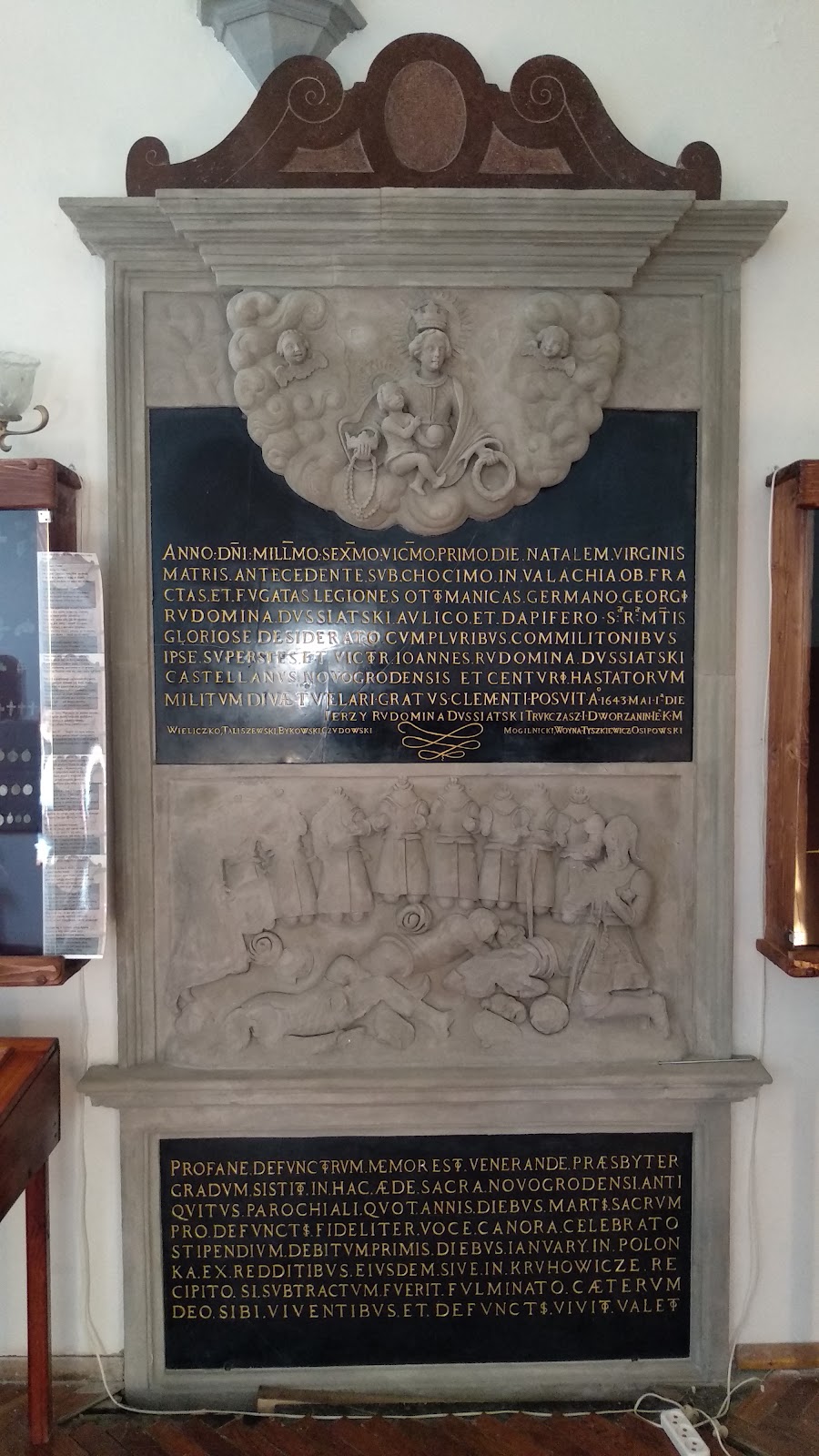
And although the current church was re-built in the XVIII century, the cenotaph survived the storms of history (Soviet hordes 1919-20AD, then the invasion and occupation by the German Nazi bestial savages 1941-44AD, and finally the rule of the only ‘just’ Red system (1944-90AD), and although mightily damaged, it can be admired in the said church of the Transfiguration of Christ in the old ducal city.

Fortunately and happily, during the XIX century, some unknown artist drew a cenotaph and then the drawing was copied in the form of a lithograph printed by the Lemercier company in Paris, France, the so-called Vilnius Album, edited by (?) J.K. Wilczyński, published in Paris 1845-1856, volume 2, and the publication itself was financed by a descendant of the Rudomina family.

Finally, on academia page of dr Katarzyna Kolendo-Korczak, you can read her article about the very cenotaph (in Polish) still located in the ToC church in Nowogrodek.
Valete

