Showing posts with label Polish horse-related words. Show all posts

Tuesday, August 9, 2022

Karmazyny i żuliki. - Polona

 Salvete Omne,

[in Polish]

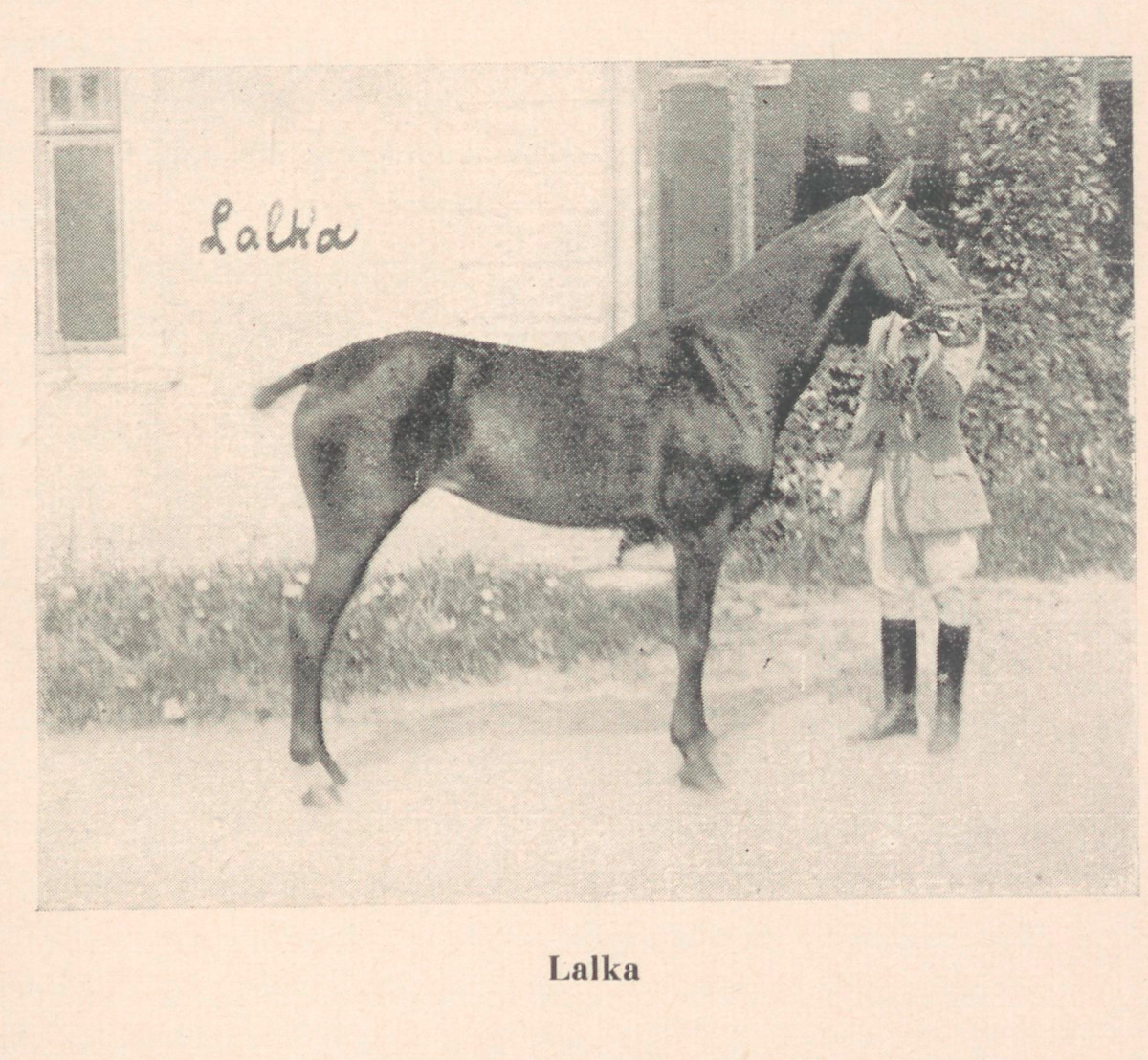
Mitzi 'Dumkollerka' - klacz irlanderka


Super 'wyścigowe' czytanie na lato czy inne 'końskie' pory roku sprzed 100 lat:
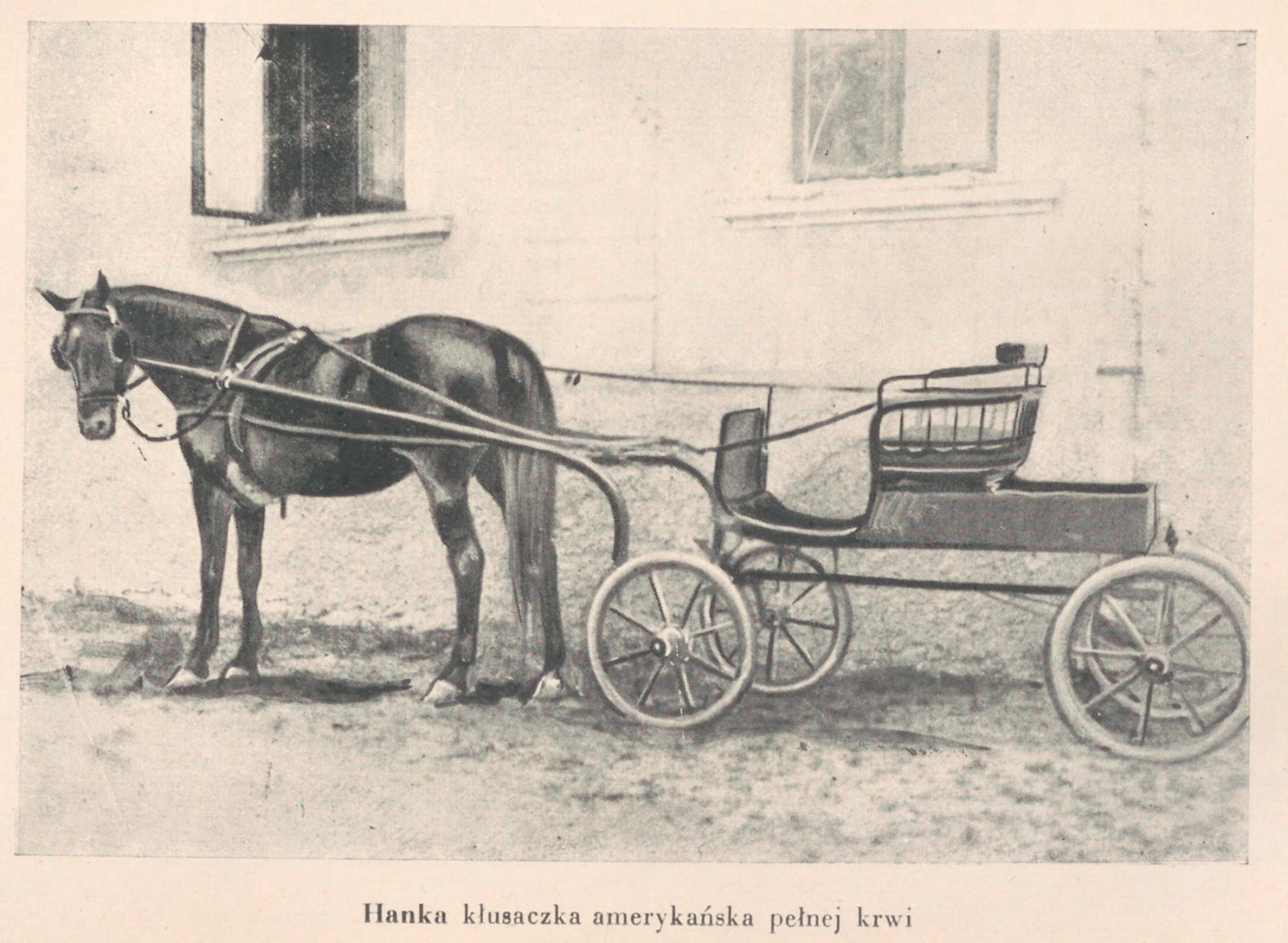
- Karmazyny i żuliki., pióra  Jerzego Strzemię Janowskiego (1888-1938), wychowanego i zyjacego w Strutyniu koło Złoczowa, którego był do 1919 właścicielem i majątku, i stajni wyścigowej a hodowlanej (nota bene tomy dzieła pt 'Słownik geograficzny Królestwa Polskiego i innych krajów słowiańskich' były ufundowane przez Witolda Leona Juliana Zglenickiego i innych polskich milionerów pracujących głównie w Baku przed 1917 rokiem). Książka nie jest li tylko opowieścią o koniach autora, ale i o świecie jeździecko-wyscigowo-hodowalnym przed 1914 rokiem w zaborze austriackim, a także o psach i pieskach autora etc... Gdyby były jeszcze krowy a trzoda, to pewnie można by było rzec, ze autor wyprzedził o wiele długości końskich Herriota i jego  ''Wszystkie stworzenia duże i małe'' . C'est la vie.

to i załączę pieśń o psach z książki


***


Spis treści - 


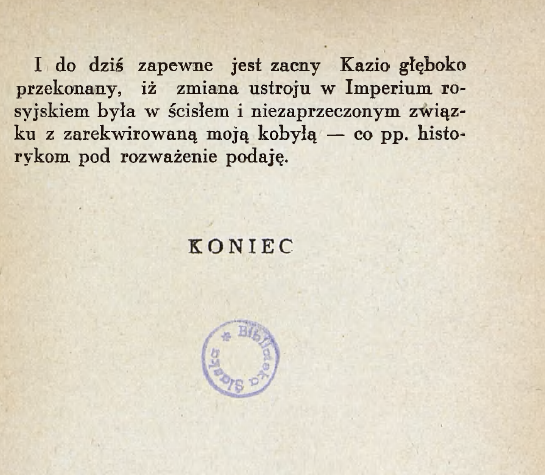
i opowieść z końca książki - 


Valete

Friday, September 10, 2021

Rusinowski i jego poczet husarski AD 1616

 Salvete Omnes.

[Polish]

wrzesień z punktu widzenia historii naszej nie jest łatwym miesiącem na wspominanie  - min. głownie dlatego, że  wszyscy zdają się pamiętać li tylko klęskę i tragedię roku AD1939 (i całej wojny 1939-45 i późniejszego okresu partyzanckiej wojny z najazdem ZSRR i consortes), zapominając o wielkich przewagach naszych przodków i klęskach zadanych wrogom naszym w bitwach potkaniowych, walnych, zagonach i oblężeniach etc w epoce staropolskiej.

A właśnie w  tym miesiącu przypada rocznica, i to okrągła bo czterysetna, jednej z najważniejszych i największych  bitew epoki staropolskiej - Chocimia 1621AD, gdzie połączone armie Rzeczpospolitej i przy udziale kozaków zaporoskich zwycięsko starły się z samym sułtanem Osmanem II i  całą potęgą Imperium Osmańskiego i jego wasali na terenie księstwa Mołdawii w warownym obozie wokół zamku i   miasteczka Chocim nad Dniestrem (dzisiaj Ukraina).

Dzisiaj chciałbym zapoczątkować serie wypisów na temat tej pomyślnej bitwy, kampanii oraz jej uczestników zamieszczając tutaj opis wyposażenia pocztu husarskiego mości pana Stanisława  Rusinowskiego  z AD 1616, pocztu typowego do epoki, bo na 3 konie tj towarzysz i 2 pocztowych, - zaczerpnięty z książki Radosława Sikory pt 'Wypisy źródłowe do dziejów husarii' , strony 107-109- jednej z ważniejszych prac wydanych ostatnimi czasy dotyczących historii najpiękniejszej jazdy świata - naszej skrzydlatej husarii.

Poczet ten i inne poczty z roty husarskiej Jarosza Sienkiewicza idącej taborem pod Smoleńsk AD 1616, na wezwanie hetmana Jana Karola Chodkiewicza, zostały napadnięte i ograbione przez swawolne żołdactwo na grobli 'na strzelanie z łuku oddalonej' od miasta Hłusk w Wielkim Księstwie Litewskim.

„Towarzysza pana Stanisława Rusinowskiego szkody:
parepę pod nim postrzelono i zabito złotych pięćdziesiąt, 

konia jezdnego postrzelono na powodzie złotych dwieście, 

żywności wozów cztery, z rozmaitymi leguminami złotych pięćdziesiąt pięć, 

wóz z czterema końmi siwymi, kosztowały konie złotych sto, za wóz kryty złotych dwadzieścia, 

zbroi polerowanych z szyszakami trzy złotych sześćdziesiąt, 

namiot turecki złoty pięćdziesiąt, zarękawia drobnego par dwie złotych pięćdziesiąt, strzelby różnych sztuk sześć,

złotych pięćdziesiąt, olstra z aksamitnymi workami cztery złotych osiem, koncerzy dwa złotych dziesięć, 

siodeł husarskich trzy złotych trzydzieści, nagłówków trzy z uździeniczkami złotych pięć, kord złotych cztery, 

półszorek nowy złotych osiem, puśliska dwoje złotych dwa, popręgi dwa kirem podszyte złotych dwa, delia czerwona,

pętlice czerwone, szlamami podszyta złotych czterdzieści, kurta czerwona falendyszowa, 

pętlice złote, guzików złocistych trzydzieści złotych dwadzieścia,

guzów złocistych tuzinów pięć w cętki robionych złotych dwadzieścia pięć. 

Rekognicyja do wojska na złotych dwadzieścia pięć, tamże i listy rozmaite i oblig tamże do wojska 

na koń sto pięćdziesiąt litewskich, chusty białe złotych dwadzieścia, czapka falendyszu czerwonego misiurka,

 w niej wyłogi sipskie złotych sześć falendyszu czerwonego łokci sześć, złotych osiemnaście, 

lazurowego[falendyszu] łokci trzy złotych dziewięć, butów safianowych z ostrogami par sześć złotych sześć, 

pościel, materace, kołdra, płotek, wały, poduszki atłasowe złotych pięćdziesiąt, welense trzy złotych dwanaście, 

szuflada z ładunkami, prochami, formami, ołowiem z bastrumentami i drobiazgami rozmaitymi żelaznymi złotych dwadzieścia, 

korzenia za złotych dziesięć, kobiercy tureckich trzy złotych dwadzieścia cztery, magierka preszburska złotych trzy. 

Stajenne rzeczy, koce, prześcieradła, deki, kulany, wyciągacze, popręgi, kantary, uździeniczki, rynkgorty, zgrzebła i 

insze drobne stajenne rzeczy złotych dwadzieścia, sukna brzezińskiego łokci piętnaście złotych cztery, 

kuchenne rzeczy złotych dziesięć, czeladnych rzeczy osiem sukni pachołków, chusty białe, kożuchy, koców złotych czterdzieści.”


W toku prywatnej korespondencji z  dr Radosława Sikory  na temat wielkości pocztu mości pana Rusinowskiego, otrzymałem taką informacje co do składu tego pocztu, którą poniżej zamieszczam i za którą dziękuję:
 

'Poczet ten posiadał: 1 towarzysza, 8 czeladników (z tego 2 pocztowych i 6 luźnych), 5 wozów.

Prawdopodobnie 12 koni do wozów, 2 konie dla towarzysza (parepa i jezdny), 2 konie dla pocztowych, 1 koń dla luźnego (17 koni).' 


wygląd pocztu zilustrowałem taką oto grafiką specjalnie wykonaną na te okazję -


nota bene całość cytowanego źródła jest opatrzona przypisami, i można sobie postudiować te i inne dokumenty źródłowe w wyżej wymienionej pracy.

Valete


Tuesday, July 31, 2012

Polish-Lithuanian Commonwealth - some Sketches

Salve,
I have been away from my studio so this month's output of my new posts and images is thin , mea maxima culpa.
...
Allow me to share with you some sketches that are still very 'green' and will eventually end up as illustrations to various posts, albeit in the future.

Hussaria or winged hussars


Nobleman

Trumpeter or trębacz

Kawalkator or horse trainer


ps
I did some illustrations for maestro Christian Cameron, actually for his new e-book. The action takes place in the Medieval Southern Europe (starts in France during the last stages of the Hundred Years War, via Venice to newly conquered Constantinople) after 1453 AD ; and main character is a young but quickly growing up Englishman aptly named Tom Swan. The novel will be released next month and it is a fine piece of historical adventure. I had the pleasure of reading it and enjoyed every little bit of it. Once the novel is released I will post here my drawings, as they show Byzantine horsemen (presumably of Morea), Medieval horses and tack and riders etc.

Saturday, December 31, 2011

Polish rider from a map of the siege of Toruń AD 1658

Salve,
this year is ending and yesterday was the anniversary of the capitulation of the Swedish garrison of Polish city of Toruń (during the war known in our history as the Deluge aka Potop - AD1655-60) to the allied Polish-Hapsburg armies (siege lasted almost 6 months).

Jerzy Sebastian Lubomirski, one of the Polish commanders of the siege,  ordered a map printed commemorating this important victory.


From this map comes the partially hidden image of a Polish horseman on a splendid mount, with a Tatar-Turkish style ''buńczuk'' (horse hair tug) suspended from its bridle (with a curb-bit).  Interestingly the sword held by the rider is a typical Polish saber of the period, and the manner of holding is quite faithful here, except that is seems to be missing the ''paluch''(thumb-ring) so peculiar to XVII century Polish cavalry sabers (but also present in earlier Swiss and Hungarian sabers); to his right we have a rare image of the Polish infantry of the period.


A detailed story of the siege by Tadeusz Nowak - in Polish - from Kujawsko-Pomorska Biblioteka (digitalized books), or from Kismeta in English.

Sunday, December 18, 2011

Pan Zawadzki with king Charles I of England, Scotland etc


Salve,
sometime during 1633 our king Władysław IV sent his envoy, starosta of Swiecie pan Jan Zawadzki, to the various royal courts of Europe, including the Stuart court in London.
In June 1633 Polish embassy reached England.
There is a description of the gifts from our king to the King of England, and here as always, our good king regaled his English counterpart several riding horses, dressed and with then typical horse tack used in Polish-Lithuanian Commonwealth:
''Rzędom też oprawnym bardzo się dziwują, że w Anglji takich niewidali, także też i koniom, jakoż Cavalcator Królewski powiedział ża żadnego takiego u Króla niemasz.''
 -Our adorned, [precious stones etc], horse furniture (back in XVII-XVIII century ''rząd koński'' included both all the harness and the saddle with stirrups)  they are wondering about since they have not seen those in England, also they have not seen the horses [of our embassy], thus the Royal Master of Horse has stated that there is no horse similar [to ours] in the Royal stables.
 ...
Po prywatnej audyencyi oddał Jegomośś te konie Królowi Jegomości ubrane w rzędy z pałaszami z buławami. Dzianeta po usarsku z rzędem turkusami osadzonym, lamparth na niem, na gniadego, drugi rząd po Arabsku łuk, sajdak, rząd barzo piękny, w nim turek cisawy których obu rączości i gotowości wysławić nie mogą.
 -After a private audience [of our envoy with the King] the envoy gave these horses to His Royal Highness tacked with horse furniture, with palashes (pałasz) and maces (buława).  Bay jennet in winged hussar fashion tack, his harness adorned with turquoises, with a leopard pelt [under the saddle]; second horse furniture was in in an Arabian fashion, with a bow and bowcase, his tack very beautiful, carried by a chestnut Turkish hors;  they, [the English], cannot praise enough the swiftness and [level] of dressage of both [our] horses..

 ...

Also the Polish envoy brought another 'horse gift ' for the English monarch, a carriage with 6 carriage horse, presumably all the same in color and size (their color has not been given in the depiction). as it was our Polish custom of the times. There were also priceless Siberian sables for the queen,
...

...
ps
the images are from a later part of XVII century, from Sweden, and show two manners of presenting Polish horses : winged hussar horse tack and 'Arabian' tack . The hussar horse furniture in the top image lacks the wild cat, leopard, tiger or lion pelt.

Saturday, December 17, 2011

A few horse words in Old Polish describing a pacing horse


Salve amici,
the year is drawing to an end so allow me to talk about some horse 'things'  long neglected. i.e., my blogging.
  in the XVI-XVIII century Polish writings  these words - ''stupak,'' ''stępak,'' ''szłapak'' - often appear to describe for a certain kind of a riding horse.
Samuel Bogumił Linde in his monumental work ''Słownik jẹzyka polskiego'' (Dictionary of Polish Language , 1812 AD) vol. 5, page 415 explains 'stępak' as a pacing horse/caballo de paso (in XIX century Polish a 'jednochodnik,' now it is 'inochodziec'). In the older Medieval sources: Latin ''pro equo ambulatore/ambulato''these names were used as palefroi (French)/palfrey(English),  podjezdek/stępak (Polish).
 Perhaps it is worth mentioning that in 1392 King Władysław Jagiellon paid 21 grzywna for a ''stepak'' (ambulator in the sources) and gave this horse to the Masovian duke Siemovit's wife as a gift...

Well, let us look at some sources from XVI-XVIII centuries:
 ...in 1596 AD Vatican envoy segnor Vannozzi visitng chancellor Jan Zamoyski always had been given 'tarant'(an appaloosa) 'stępak'  to ride to his estates, so when he finally left Poland the chancellor had given him the same horse with a saying:... equum graduarium, ut commodius possem redire in Italiam (a pacing horse, so I would return to Italy comfortably).

when the Polish embassy of Lew Sapieha came to Muscovy in 1600, his secretary Eiljasz Pielgrzymowski wrote a diary of that mission (delicate one as less than a decade later  Polish-Lithuanian Commonwealth would enter into war against the Muscovy Russia)- the embassy members gave Tsar Boris' son Fiodor, amongst many other horses and valuable gifts, two pacing horses:  a ''koń cisawy drygant stupak'' - chestnut pacing stallion (''drygant'' in Polish besides being a stallion could signify a very spirited mount) and a ''koń Turecki stupak siwy'' - grey Turkish pacing horse.

Let us jump almost a century and a half, to 1744, when another Polish writer, Marcin Matuszewicz (author of Memoirs of 1714-1765), noted that ''podobał się królowi* koń brata mego, szłapak brudno szpakowaty, za którego dałem w Wysokiem dukatów szesnaście; kazał go sobie król przejeżdżać na dziedzińcu i kazał zapłacić za niego 5o dukatów. Był ten koń faworytem królewskim i już potem król oprócz tego konia na innym nie jeździł...'' 
(the King* liked my brother's horse, dirty dark-grey pacing horse, I had paind 16 dukats for it in Wysokie, the king ordered the horse ridden in the courtyard and ordered to pay 50 dukats for him. This horse was the king's favorite and after that the king would not ride any other horse than this one...) 


*
the king in question is Augustus III of Poland 
ps
the two images above show training of the stepping/pacing horse, the first image is from 1680s and the second is from the second half of XVI century. The last horse image is a fabulous grey Spanish stallion, painted in the early XVIII century.

Tuesday, November 23, 2010

Muscovite Reitar 1660s - update I

Salve,
a bit of an update on my Muscovite Reitar started here muscovite-reitar-1660s


I added double reins and a curb-bit (Polish. munsztunk) on a horse, made horse's neck a bit longer;  on the officer - a longer beard (hope you like it better, Kadrinazi),  and then some other little equipment parts that make this soldier appear more 'historic'
pa ka

Friday, December 4, 2009

Hussar officer - Imci Pan Porucznik

czolem,
let me return  for a little moment to the Polish-Lithuanian Respublica of the 17th century with this little sketch of a Husaria officer.
I hope to 'paint' it digitally some time soon.  Meantime he will be riding this blog in black and white. Please note that in a Turkish fashion (or perhaps more ancient - Macedonian and Scythian) his horse has a leopard skin spread underneath his eastern (Turkish-Tatar) saddle. His Hungarian style boots are placed in the Polish (of Tatar origin) stirrups and he guides his horse with an aid of the heavy German-style 'munsztuk' (Polish for 'curb-bit'), as advised by the famous Polish-Lithuanian author,  aristocrat, and winged hussar himself Krzysztof M. Dorohostayski (Dorohostajski or Дорогостайски) , of Leliwa coat of arms, a great rider himself, participant of many wars, eg war with Ivan the Terrible, war with Sweden where he distinguished himself as a cavalry commander under the command of grand hetman Krzysztof Radziwiłł Piorun at the victorious  battle of Kokenhausen (Koknese) June 23, 1601...
He is the author of this worthy Polish language treatise on horsemanship titled  'Hippica' , published many times during the 17th century in the Commonwealth, now accessible on google books - thanks google :)
http://books.google.com/books?id=qwgEAAAAYAAJ&pg=PA120&dq=hippica+konie&as_brr=1&ei=PlYZS_bvIKT8ygTHr7WhBA&client=firefox-a#v=onepage&q=&f=false
for your enjoyment I hope ...
pa ka [Valete]

Saturday, March 28, 2009

Zygmunt III king of Poland and grand prince of Lithuania


I found this image of our king Sigismunt III Vasa on wikipedia. We know now, based on the primary sources of his reign, that he was the first to receive the newly bred Spanish Andalusian Horses from the studs in Cordoba and Austrian at Lippica, his wife's family, the Austrian Habsburs, were the givers/ senders of these horses. We had used to call them Dzianet, after Jennet Genette, prior to the Corboban breed being established (AD 1576-9), so naturally they kept calling them 'dzianet's from Spanish 'el jenet', genete etc, as 'rumak' (from Turko-Persian argamak) was still reserved for the Oriental horses. Perhaps in this print Zygumunt III rides a Cordoban Spanish stallion, celebrating his armies' victory over the Turks at Chocim (Khotin) A.D. 1621.

Note that Richard Brzezinski et late Angus McBride (painter) reconstructed a winged hussar wielding a hussar lance (plate depicting Vienna AD 1683) in the same manner as Zygmunt here, in their Osprey book "Polish Armies 1569-1696" vol1. Perhaps the print was their inspiration, and obviously wrong, as the hussar lance or kopia was many between 3,5m to over 6meters long. Impossible to hold this lance in this manner. My friend Radek Sikora writes about the hussar lance in his articles accessible at http://www.hussar.com.pl/162/husaria-cz-3-radoslaw-sikora accidentally in this particular article there is my own drawing showing a long lance wielding hussar attacking a pikeman, circa AD 1626-33.