Showing posts with label Philips Wouwerman. Show all posts

Thursday, July 9, 2026

Cheiron Journal - 1st issue od 2026

 Salvete Omnes,

Philips Wouwerman


a short entry - 


Hear, hear - a new issue of 2026 of the Cheiron Journal has been made available on the website. 


Free access articles - eg: 
1 - The Image of the Horse from its Origin to its Transformation in the Bronze Age of Eastern Europe / Western Asia by P. F. Kuznetsov

2- Bronze Figurines of Domestic Horses in Central Ciscaucasian Burials of the Second Quarter-Middle of the Third Millennium BC  by Alexey A. Kovalev


also on racing etc


ps
This year Grunwald 1410 battle reenactment will take place the weekend of 17th-19th July  in northeastern Poland-EU.


On Yt channel Polish reenactors group - Grupa Konna Dextrarius as the Teutonic Knights at theMalbork Castle, Poland.

*

Valete

Friday, December 27, 2024

Philips Wouwerman - the Nativity related works

 Salvete Omnes,

Christmas has passed but the holiday season is still on  until January 6.


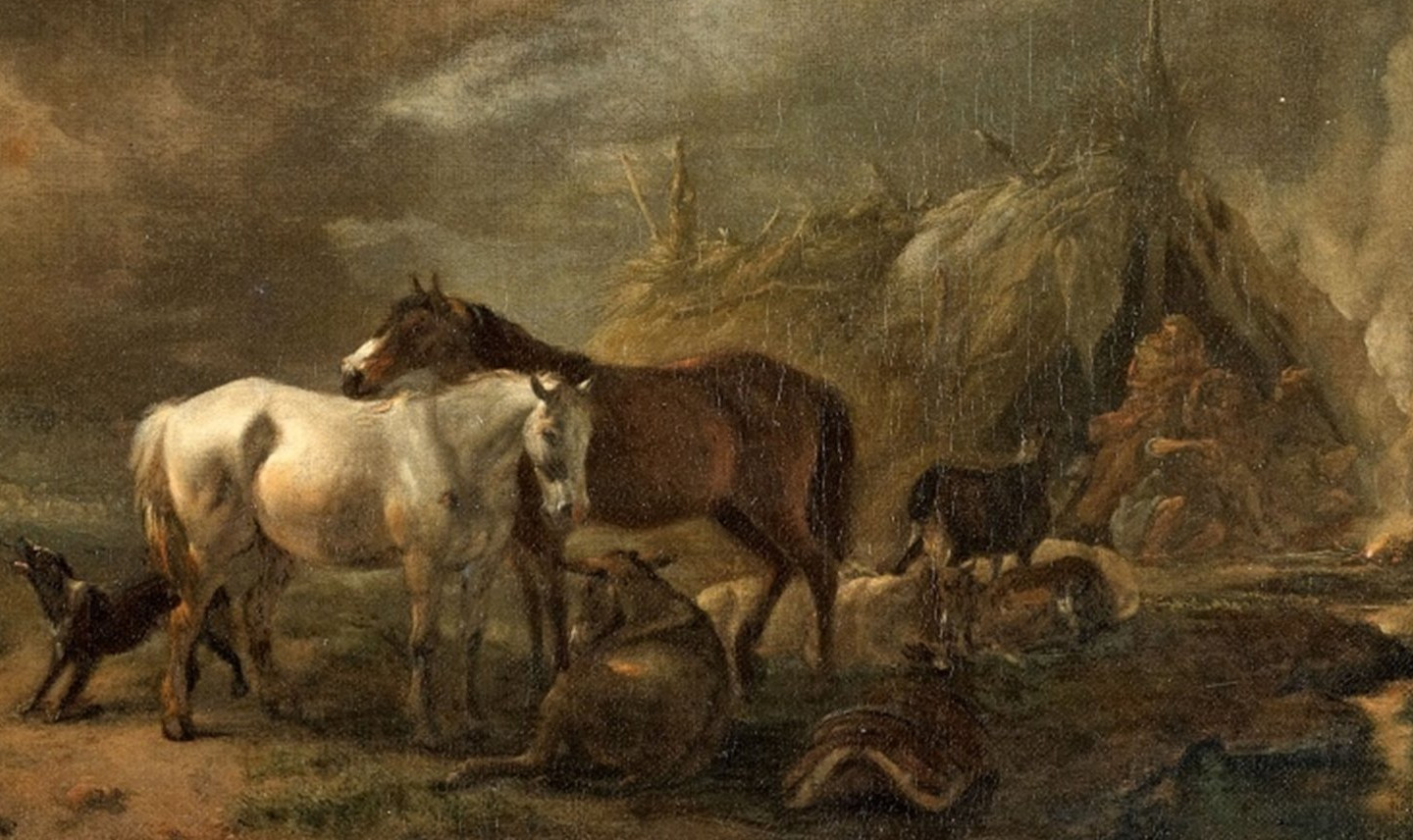
So I would like to bring to your attention two works by Philips Wouwerman.
these two works deal with the often omitted shepherds. Very much a Baroque painting in full 'gallop' - dramatic light, 

as usual we are very much interested in horses
pack saddle on the ground, next to the donkey 


.
Dresden Gallery has had a version of this Annunciation.
description of the painting and author - from Christie's site

another shepherds Annunciation painting from the National Gallery of Ireland.

and yet another Annunciation to the Shepherds painting - Koetser Gallery (large resolution with great details)

In addition two more works dealing with the travel on foot, on horseback or donkey-or-mule back. 


Valete

Saturday, December 21, 2024

Wouwerman - a scene with a saddled horse and wagon

 Salvete Omnes,

three days to Christmas' Eve - we have to go get the Christmas tree today. 

while perusing Wiki Commons I came across this drawing by Philips Wouwerman - originally this artwork comes from the German state collection.  

.

the saddled horse is interesting - long, strong legged and rather hunter-like, long tail and of a round belly, a picture perfect cavalry horse? 

here I colorized, gently, the saddle and his tack, and the huge 'mantelsack' (?) on the back of the pack horse.
 
nota bene the draft horse pulling this wagon carriage have some serious collars. 
enjoy

Valete

Saturday, October 9, 2021

Flat saddle? XVII century

Salvete Omnes,


something to think about - the development of the flat saddle aka English saddle 


XVII century Dutch and Flemish painters show us some images that can be considered interesting in the aforementioned aspect - 


..


..


Valete

Saturday, October 2, 2021

Pieter van Laer - more horses

 Salvete Omnes,

some equine-related fine art  from Dutch painter and etcher from Haarlem Pieter van Laer (a while back I wrote about him)  , who spent most of 1630s in Italy, and whose  sketches  probably were used later on by Philips Wouwerman, when he painted his Italianate canvass. Master Wouwerman was greatly influenced by Pieter's work - says National Gallery of Art  in Washington.

paintings

detail of his painting Rest duriing the hunt -


Now, in this painting - at Christies - attributed to a follower of van Laer there is a figure or red clad rider with a fur  hat,  on the right  next to a waterfountain, who appears dress in a Polish zupan? 


etchings and prints


all from WIki commons

Valete

Sunday, January 5, 2014

Baroque saddle - Certamen equestre


Salve,
king Charles XI's horse carnival  or carrousel in the spirit of haute école included naturally splendidly outfitted horses and riders in Baroque style prevalent during the 1670s. After all Sweden was then an empire, albeit strongly influenced by the pomp and splendour of the French court of Louis XIV.
However, the French did not invent the carrousel, it had probably been practised in some form since the late Middle Ages, and as the knightly tournaments were dying off it was refined in the very divided, but culturally very homogeneous Renaissance Italy, especially since the riding schools serving the aristocracy appeared with Grissone and others in 1550s, then the carrousles were brought to opulence at various Baroque courts of Europe, I am not sure if they had them in England or Scotland during the period. The carrousels lasted into XVIII century,

Eward Phillips (New World of Words, 1658) defines Carrousel as:
''Carrousel, a magnifecent Festival made by Pricnes and Great Men, upon some occasion of public rejoycing, and consists in a Cavalcade or Nobility sumptousl apparel'ed, and clad after the manner of the ancient Kings, who repairing to som public Piazza, shew their activity in running at the Ring, Jousting, Torunaments, and such other noble exercise."*
Back to the saddles, so during XVI century there were the ones like these saddles:


then they evolved, with saddles varied from everyday ones, through miltiary ones to parade examples:


Sadly, the engravings do not show the stirrups  with these saddles.


A horse mannequin dressed for Certamen Equestre
Enjoy
*
original spelling after Vladimir Littauer, Horseman's Progress, New York 1962, p. 67 .
ps
interesting website devoted to historic riding