Showing posts with label Shahnameh. Show all posts

Thursday, April 2, 2026

Panthera pardus tulliana - Caucasian Leopard

 Salvete Omnes,

detail from Shahnama Ad 1525


We are in la Semana Santa (Holly Week) leading to Jesus Christ Great Friday Crucifixion, and then the pinnacle of Christianity - the  Resurrection on  Easter  Sunday.

There is also the illegal war in western Asia, US & Israel bombing Iran and Iran sending missiles and drones against the American and Israeli assets...  Awfully dangerous conflict, that could lead to the nuclear world war III. There is also war against Christians, war in Ukraine (Russian aggression against the Ukrainian state).


Ad rem, the title of this post is the Latin name for a Caucasian leopard, the Western Asia- Southern Europe subspecies of the great cat. Here about the cat in present day Armenia. eg Pakistan here


while looking at the Ilkhanid, Timurid, Safavid and Ottoman miniature illuminations we often see light spotted skins worn by heroes and warriors or soldiers. 


I think the many of these leopard skins in these paintings were made from the hides of the Panthera Tulliana leopard


. the hero of Shahnameh
Rustam astride Rakhsh in his leopard hat and tiger fur kaftan 

Rustam in his leopard hat, tiger coat/kaftan and his brave horse Rahksh


even horses were covered in these pelts


Turkish Deli


from Raalamb Costume book - Ottoman Turkish soldiers Janissary Corps


Georgian warrior in Rusatvelli's Knight in a Panther Skin


finally our Polish and Hungarian hussars who adopted the leopard hides as part of their panoply 


enjoy

Valete

Friday, March 13, 2026

Iranczycy nie Persowie plus chronologia Iranu - Iranians not Persian and short history of Iran

 Salvete Omnes,


[my post contains links to a video material in Polish only]


The air war between Iran & their allies and US (all the best to our boys & girls) & Zionist Israel rages in the Middle East and, obviously,  in the social media -but I daresay Twitter X is the best forum for the info (perhaps Telegram too?) .


Polish professor Gosciwit Malinowski prepared two presentation on Iran and their history etc on Ytube, but they are in Polish only. Amazing skill and knowledge and talent to tackle the topics.


Zapraszam do przesluchania - 

Krótka historia Iranu: 100 tysięcy lat w 100 minut

Dlaczego Iran a nie Persja: tożsamość narodowa Irańczyków

.


I hope POTUS D. Trump will end this war, let us pray, this weekend, declaring his  satisfaction with the   accomplishments of the military campaign and the political aims realized. 

Valete

Wednesday, June 1, 2022

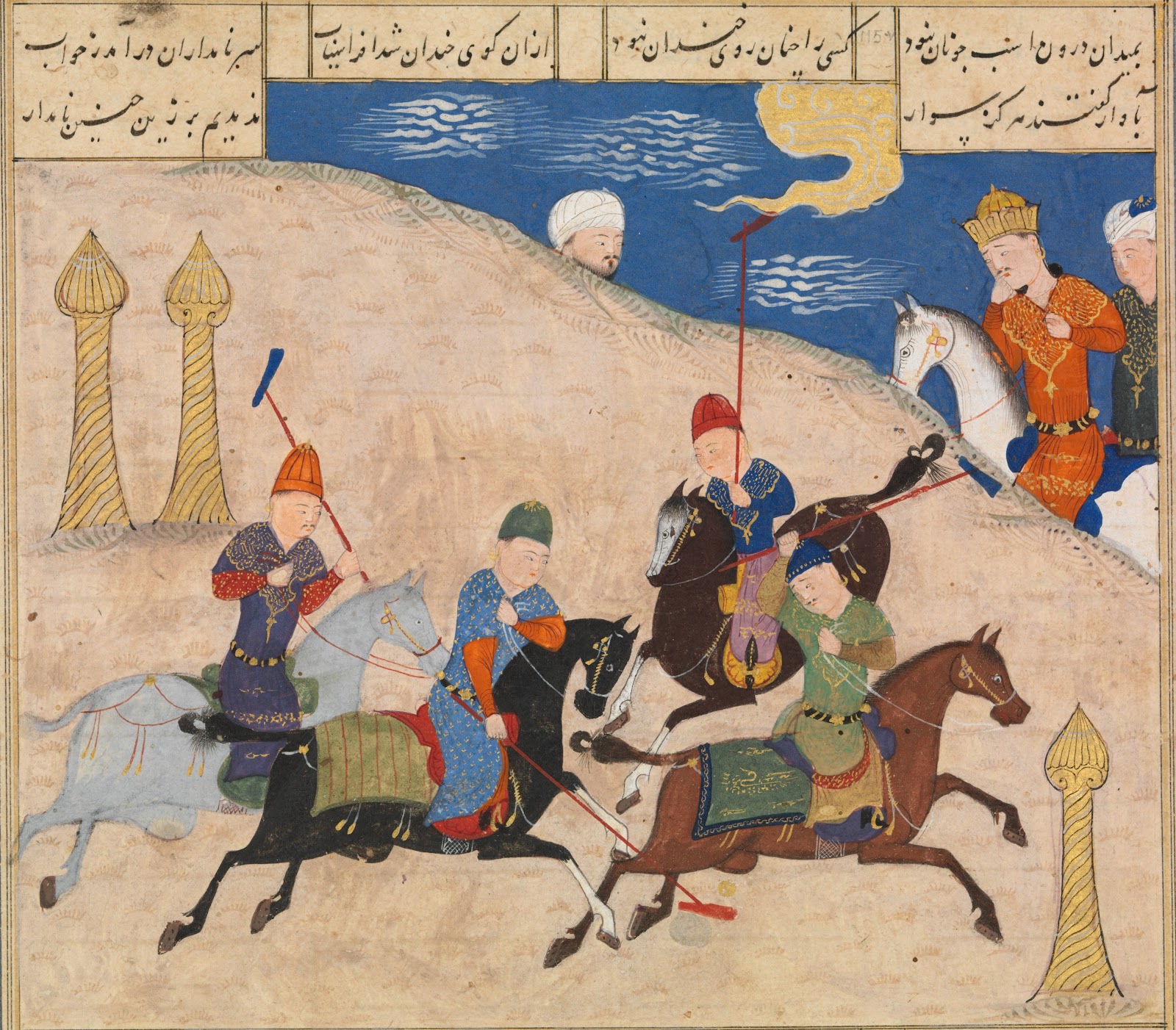
Polo - XV century miniature from Persia

 Salvete Omnes,

from the Chester Beatly Library comes a rare XV century miniature of horsemen playing polo - titled ''Siyavush plays polo before Afrasiyab.' A folio from the Book of Kings (Shahnama) painted circa 1480AD.


During the turbulent XV century the Timurid Empire crumbled in the west, and Aq Qoyunlu Turkoman sultanate conquered most of Persia. These horsemen playing polo are dressed in the period costumes and equipment, albeit they portray persons and events taking place described  in the great epic of Shahnameh. 
The 540 years old miniature should be distinguished for its beauty and quality of line and painting.

enjoy

Valete

Friday, January 24, 2020

Rustam and Rakhsh - epic poetry


Salvete Omnes,

today let us read, in verse, from the Ferdowsi Tusi's Shahnameh about  the  truly epic hero Rustam/Rostem and his equally epic stallion Rakhsh - and how they came about to be together. The book of Kings or Shahnameh is like the Iliad of Homer - perhaps sung in the Achaemenid Empire (some book of kings was allegedly  already  in existence  according to the now lost works of Ctesias - V century BC Greek writer) and then  composed and written down by the poet from Tus almost 2000 years after the Homer's epic.

This epic English translations was done by the Warner brothers (Arthur George and Edmond) -  volumes available on archive.


and some Islamic miniatures from archive and the Wiki Commons about this warlike pair


 to be continued
Valete

Friday, July 18, 2014

On the Sogdian painting and Sassanian connections

Salve,
 I am always interested in all things pre-Islamic and early Islamic greater Persia, this time I want to share with you a link to an article titled  'Sasanian traditions in Sogdian paintings: hunting and fighting scenes' by Geri Della Rocca de Candal, available for reading or download at academia.edu (or a link via this interesting Facebook page titled Eran ud Turan ). Sogdiana or Transoxiana or Turan  was the land of Silk Road traders, horse breeders, artists and sometime warriors living in the shadow of the great empires of Persia and China and roamed by the Saka and later Turks/Turkuts, until conquered by the Arabs during the VIII century AD (and known since then  as Ma warāʾ al-nahr).  Introduction to the Sogdian art via iranica.com.

Persian and  Sogdian hero Rustam/Rostam (known to us through Shahnameh/Schāhnāme of Ferdowsi - nota bene article on early illustrated version of Shahnameh from 1333AD) in his splendor from a mural at Panjikent (image from Wiki Commons)

Last days of Panjikent - article - and if you curious more about the last ruler of that Sogdian city and his famous palace at Mugh Mount.

From my own stable :)  I drawn this image from a metal plate of Pur-i Vahman, it represents my newest attempt at copying this image. For our interest his stallion's bridle includes the dropped-cavesson (metal noseband) plus bit arrangement, horse's tail tied like a swallow's one,  then a cropped and cranetallated mane, and clearly depicted stirrups in more or less steppe and Korean fashion. Horse tack is still adorned with Persian elements (horse tail and a phalera), reflecting Sassanian and Saka traditions.

Dr  David Nicolle talks about this plate in his other book - Armies of the Islamic Conquest (Osprey Publishing, page 42).


Friday, June 26, 2009

Progress and corrections on the King of Kings hunting


hello,
summer is about to hit us with some warm weather in NYC, so definitely there will be less work to be done at home :)
Some little corrections (his bow mainly as I was advised on the great forum for ancient world military history enthusiasts and reenactors romanarmy.com http://www.romanarmytalk.com/rat/viewtopic.php?f=25&t=26749
I did on the famous Sassanian King Bahram Gur, and started adding some color.
Plus I started working a little on some older images of the Sassanian knights... so they will make their appearance here sooner than later ;)
pa ka

Wednesday, June 17, 2009

Sassanian king Bahram Gur 'hunting' Hephthalites


Hello again,
I am working on many different sketches of the past (reworking them from drawing and watercolor paintings into the digital 'paintings'), but at this time would like to share with you something that is a curious (to me) combination of several persons efforts.
The story goes like this - the initial sketch was done based on my friend Kaveh's drawing - he did it for late Angus Mcbride so this famous illustrator could paint the plates for Kaveh's Osprey book on the Sassanian heavy cavalry, the particular plate depicting death of Julian Apostate battling Sassanian cavalry- then I did a sketch based on Kaveh's and then my friend Patryk - a scholar of the Ancient Iranian military, eg author of the Sassanian cavalry article for the Ancient Warfare Magazine vol.1, issue 4 - made many suggestions on how to improve and how to arrive closer to the probable historic appearance of such Sassanian rider wielding both a pistol grip Sassanian sword (the forerunner of a sabre grip) and short Sassanian bow.
Why the title - well, Patryk had suggested that this could be a depiction of Bahram Gur during hie famous campaign against the White Huns or Hephthalites - http://en.wikipedia.org/wiki/Bahram_V and I liked his title so it will stand...
Many thanks to Patryk :)
to be continued

Sunday, April 19, 2009

Polo


 Ushta Te,

   I have read this interesting article on Buskashi and Polo http://www.cambridgeblog.org/2009/04/buzkashi-and-polo/ written by dr Pita Kelekna, anthropologist and author of the forthcoming book 'The Horse in Human History.'
In the article, which is a part of series of articles on the horse theme & the forthcoming book  presented as a series of blog entries (quite clever and nicely introducing her book to the wider world), dr Pita writes about  the two other most ancient equestrian games Buzkashi and polo, since the first and foremost horse 'games' were obviously: horse racing, horse breaking, target shooting from horseback, and communal hunting.
Mounted warfare was the culminating and glorious end-result of all these games.

Today I just wanted to post some information about the ancient history of the Iranian game of Polo.

Actually, 'Gu-u-Chogan' is the Iranian name for Polo, while name 'polo' is a Tibetan name for a polo ball made from a willow root. 'Gu' means a ball and 'Chogan' means a stick, so it is a game of ball and stick played while ridding a horse  that after all is a player too :)
Polo is as Iranian (whether Persian o North-Iranian - Scythian and Sarmatian - is unknown) as a Persian carpet, or a Kantus (Median cloak that had become nomad attire for thousands of years, and in the 16th century ended up in Poland as a part of national costume known as Kontusz)) or a meydan (polo field).

Actually, the first accounts of the existence of chogan or the stick and ball game came from the time of Achaemenid Shah (king) Darius (Darayavaush) the Great (522- 486 B.C.).
And 2 centuries later his namesake & of the same dynasty, Darius III  sent Alexander of Macedon a polo mallet (chogan) and a ball (gu) with an invitation to play polo match instead of fighting battles. As we have learned in 5th grade (at least in the Polish elementary schools' history class) this particular handsome & chivalrous  invitation did not work and Alexander took his lance and galloped on ( a Thracian, Tessalian or Nissean stallion Bucephallas, as seen in this image from the Naples Museum in Italy) across the Achamenid Empire and eventually did conquer the whole Achaemenid world and beyond. As result the Greeks and Hellenic culture spread as far east as northern India and Afghanistan while eastern (Buddhism etc) influences filtered west into the Hellenic thought and culture.
I will write some day on Eummenes of Bactria, Gandhara, Indo-Sakas, Kushans and other equestrian rulers of that part of the ancient world.

Ad rem, there are other numerous mentions of the chogan/polo in the ancient Sassanian Persia, starting with the reign of Ardeshir, the first of Sassanian kings.
The slayer of Romans and builder of cities shah Shapur I (r. AD 226–241 and I will write about him soon, there are images of him ridding his stallions, he was a dashing warrior) when a young boy, he  was tested whether he was the real son of the already mentioned king Ardashir by use of his daring and courage during a game of polo.
Shah Shapur II (AD 309 to 379), another Sassanian ruler of Persia, learned to play the game of polo at the age of seven.
Finally, at the Sassanian courts the noble women played polo in the 'meydan' as well. The most famous of these aristocratic women was beautiful princes Shireen who played many a prince.
Also, the ancient Pehlevi text and later Persian chronicler al-Tabari confirm that when the future hunter-king Bahram V Gur( r.421–438)
http://upload.wikimedia.org/wikipedia/commons/0/01/Bahramv.jpg
was growing up he received three tutors in the arts of: reading, hunting, and polo along with skills of weapons.

So going forward just a little bit we end up with the most masterful Persian epic Shahnameh that was composed in the late 10th century.  The native Persian court poet Ferdowsi wrote into the Shahnameh plenty of references about the chogan game, by then played already in the courts of imperial China, Japan, Central Asia courts, and the Arab caliphate etc but we should remember that he wrote his epic 1500 years after the first mention of the game, as I have shown above.
Along this little introduction of the ancient polo, I am adding my own 'tracing' of one of the prime examples of the Sassanian sumptuous art - in form of metal plates with etchings or etchings and relief inside the metal plate - this website has many of them http://www.cais-soas.com/CAIS/virtual_museum/sasanian/Artifacts/metalwork.htm I am going to do a separate post about this plate and many others, God willing.
But note this king rides a stallion, the horse's mane has been crenelated in a manner most ancient to the Iranian nomads, his tail tied and adorned with ribbons (swallow tail shape, perhaps to represent the swiftness of that bird to  give a horse more swiftness as in the American Indian belief), there is an early curb-bit along with a metal cavesson muzzle and no forehead strap or nose band (cavesson replaced it), but there is a strap under the mandible in the same fashion as seen on the Persepolis relieves(5th century BC) . The cinch seems to be of some fabric and not of leather. Discs adorn breastplate and crouper, similar to the Roman and later Hunnish horse harness styles. There may be a tamga - horse owner mark - on this stallion chest. I did not concentrate on the rider so he is rendered rather elementarily.
enjoy