Showing posts with label XVI century cavalry. Show all posts

Tuesday, October 21, 2025

Pieter Coecke van Aelst - Customs and Manners of the Turks

 Salvete Omnes,

Suleiman the Magnificent 


the XVI century Flemish architect and artist (see the list of his mastery) Pieter Coecke van Aelst  produced a freeze-like series of 10 prints titled - Ces Moeurs et fachons de faire de Turcz (Customs and Fashions of the Turks)  - circa 1550sAD.


sultan Suleyman's court in procession


The prints are very pleasing  esthetically and show maestry of composition, anatomy and knowledge of proportions etc, they are also very precise in detail and contain a wealth of information about the Ottomans and their empire. 

.


.


.

.


Three world preeminent art centers- London's British Museum, NYC Metropolitan Museum and Amsterdam's Rijks Museum possess at least three different sets of these prints. 

Enjoy

Valete

Thursday, February 1, 2024

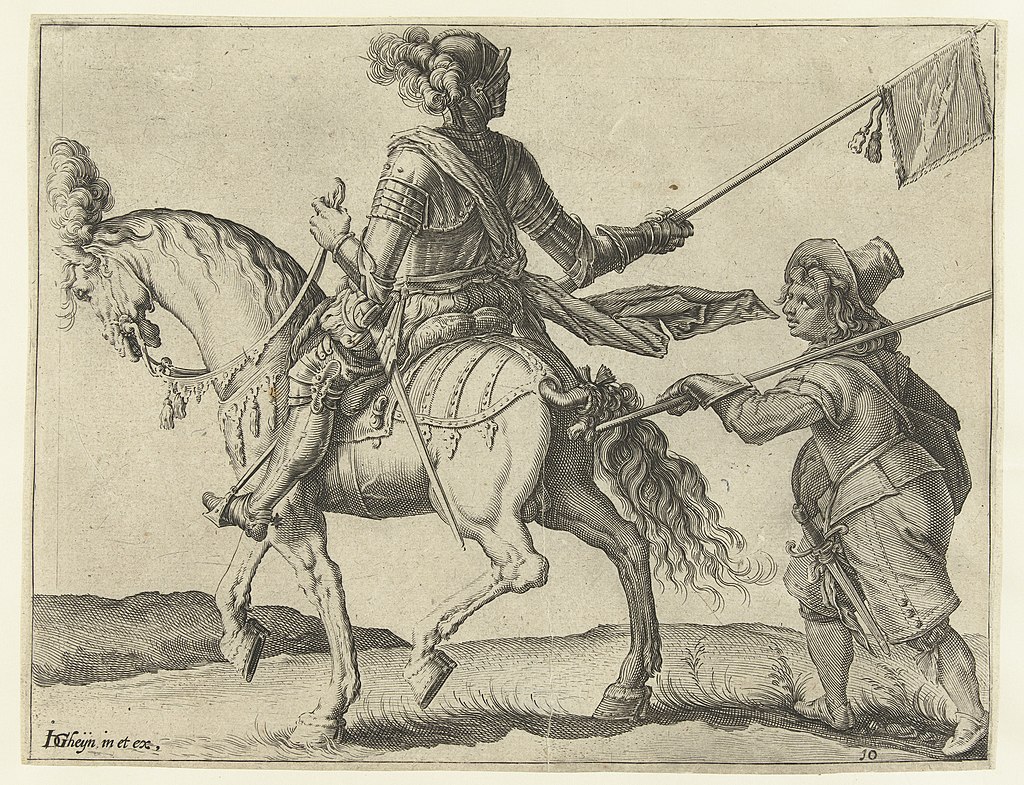
De Ruitter school - part II

 Salvete Omnes,

following the first posting of this month, this is my second - de Gheyn's Ruitter school:  the late XVI  century lancers of the Western and Central Europe - 


for your study and enjoyment

Valett

Thursday, November 25, 2021

Hungarian Hussars from Esztergom

 Salvete Omnes,

there is a group on Facebook titled 'Szlafrokow Romowy' (for reenactors , historians, and aficionados interested in the Old Poland and her neighbours costumes and attires) and Tomasz Rejf, one of the members of the group and an avid XVII century reenactor and researcher, has provided this link to the British Museum scan of a drawing (pen and ink, and watercolor) by Jacob Hoefnagel, Flemish artist, showing the vista of the Hungarian city of Esztergom circa 1595AD.

In that picture, in the right hand corner there are three hussars or lancers astride fine prancing horses and with all that finery that made Hungarian and Polish winged  hussars so picturesque, each with a different hussar lance. 


Wiki Commons has a scan of a print that was based, mast likely, on the Hoefnagel's drawing.


enjoy studying the images 

Valete

Ps

Happy Thanksgiving - :) 

Wednesday, July 17, 2019

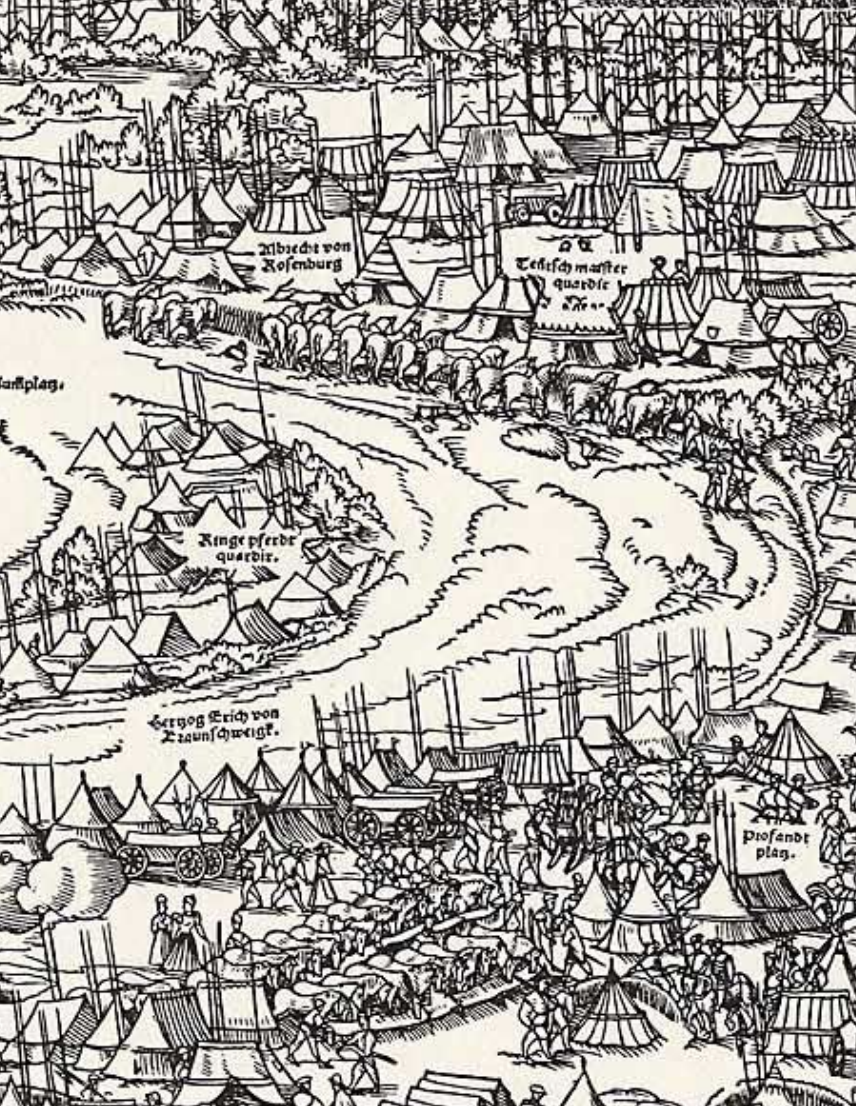
Hans Mielich - wagons and horses in the Imperial army camp

Salvete Omnes,

a short entry - maestro Hans Mielich and his woodcut showing Imperial army and their camp near Ingolstadt (via digital library zeno.org ) circa 1549AD. It was during the Schmalkaldic war when the Imperial army of Karl V/Chalres V (Carlos I of Spain)faced the Schmalkaldic  League for two weeks, it was a stand off and ended with the League army withdrawing.
I enlarged some of the details showing horses in camp, wagons and carriages, war and sumpter horses, field stables, horse feeding,  landsknechts, and lancers and their musicians, and numerous officers and men-at-arms, numerous tents and even a pontoon bridge etc.


Valete

Saturday, July 6, 2019

E-codices Illustrated Chronicle by Diebold Schilling of Lucerne

Salvete Omnes,
quick post:
e-codices portal allows for viewing, downloading and manipulating this extraordinary book from circa 1513AD, from Luzern (Lucerne), Swiss Confederation (today Switzerland) - Chronicle by Diebold Schilling of Lucerne.
Presented to the city of Luzern by its author Diebold Schilling the Younger (although clearly there were two painters doing the illuminations) they say that the chronicle remains unfinished. (I have not tried to read it at all).
This chronicle starts with the battle of Sempach and ends right before the coming of Reformation.

I perused the folio yesterday - more than 600 pages, over half of them with illuminations, and corralled for you and I some images that in my opinion contain so,me interesting images of saddles (including a saddle for driving ), horse tack, various horse types, mules and pack driving etc. This is but an entry into the rich iconographic treasure this chronicle is for many a student of late Medieval Central Europe.


nota bene the chronicle contains many images of tents, chivalry combat, combat, rapine and pillaging, traveling, farming and architecture. The illuminators show various types of arms, variety of armour, and coats of arms of the period.

eg tents


Valete!

Monday, March 25, 2019

Sir John Smithe - Instructions, Observations, and Orders Mylitarie

Salvete Omnes,


sir John Smithe or Smith, XVI century English gentleman and soldier, wrote  and had his military treatise published in 1594AD and reprinted in 1595 AD.

The entire book - 'Instructions, obseruations, and orders mylitarie : Requisite for all chieftaines, captaines, and higher and lower men of charge, and officers to understand, knowe, and observe' -  is available on google books for reading or download.


Inside there are some very interesting observations from a soldier who served on the Catholic sides seeing plenty of  action in Kingdom of France, Holy Roman Empire and in Hungaries (Hungarian Kingdom divided between the Ottoman  and Imperial powers) for about 20 years, finally returning to England circa 1572AD.

He wrote about lance bearing cavalry of the times: stradiots, men-at-arms, boder horse (particular to English-Scottish borderlands)light cavalry, and demi-lancers. He covered the equipment (like the estoc to be carried under rider's thigh in the manner of Turks or Hungarians), training, and tactics and many other things in his work.
I have just started reading and studying this treatise, looking forward to see much interesting information.

Valete
ps
all armor images are from Wiki Commons and these examples represent 2nd half of the XVI century uppermost crust of chivalry and armored horsemen. such armor could have been used by the winged hussars, be it in Polish-Lithuanina Commonwealth or Hungaries.

Sunday, November 5, 2017

Equestrian armour - Erik XIV of Sweden


Salve,
a quick post about one of the most beautiful armours ever made during the XVI century - the suit of armor for the rider and horse created  for the mad king of Sweden Erik XIV ( held presently at the Dresden Rustkammer, Saxony - Germany; nota bene I visited it first time when a kid).
This Labors of Heracles-themed suit of armor was made by armorer and goldsmith from Antwerp Eliseus Libaerts (fantastic shield attributed to this master craftsman, also a book in German - I have not seen it yet ) for the king  between 1560-65,  and he also made this suit of armor kept in Sweden. I have this book Arms and armor annual, which is a collection of articles written by researchers in history of arms and armor, and on page 104-113, French Royal Armour as Reflected in the Designs of Etienne Delaune,  author Bruno Thomas wrote about French artist Etienne Delaune, whose designs our master Eliseus copied and/or used extensively to create his Heracles-themed suits.


more fine images on this Wiki Commons page
enjoy