Showing posts with label Eugene Delacroix. Show all posts

Sunday, September 27, 2026

Portraits of equine expressions in eighteenth- and nineteenth-century paintings

 Slavete Omnes,

University of Michigan Digital Collections 


 from the Journal of Veterinary Behavior come this libre article -Portraits of equine expressions in eighteenth- and nineteenth-century paintings by Denise Pereira Leme.


.


It is free and about horse paintings, so why not to peruse it?  -   as the the proverbs go:

-don't look a gift horse in the mouth

-darowanemu koniowi w zęby się nie zagląda

-a caballo regalado, no le mires el diente

-Даровому коню в зубы не смотрят 

And what a joyous opportunity to share some great equestrian art on this blog 


.


.


.


enjoy

Valete


Tuesday, December 30, 2025

Cheiron vol.5 2025 Special Issue

 Salvete Omnes,

the end of the Old Year but a day away - so a little surprise: 

a new, special issue of the Cheiron Journal

SPECIAL ISSUE: Arabic-Armenian Encounters in Medieval Hippiatry and Hippology: Cross-Cultural Exchange Between the Muslim and the Christian East.


enjoy reading 


and 


studying the articles

Valete

Tuesday, April 1, 2025

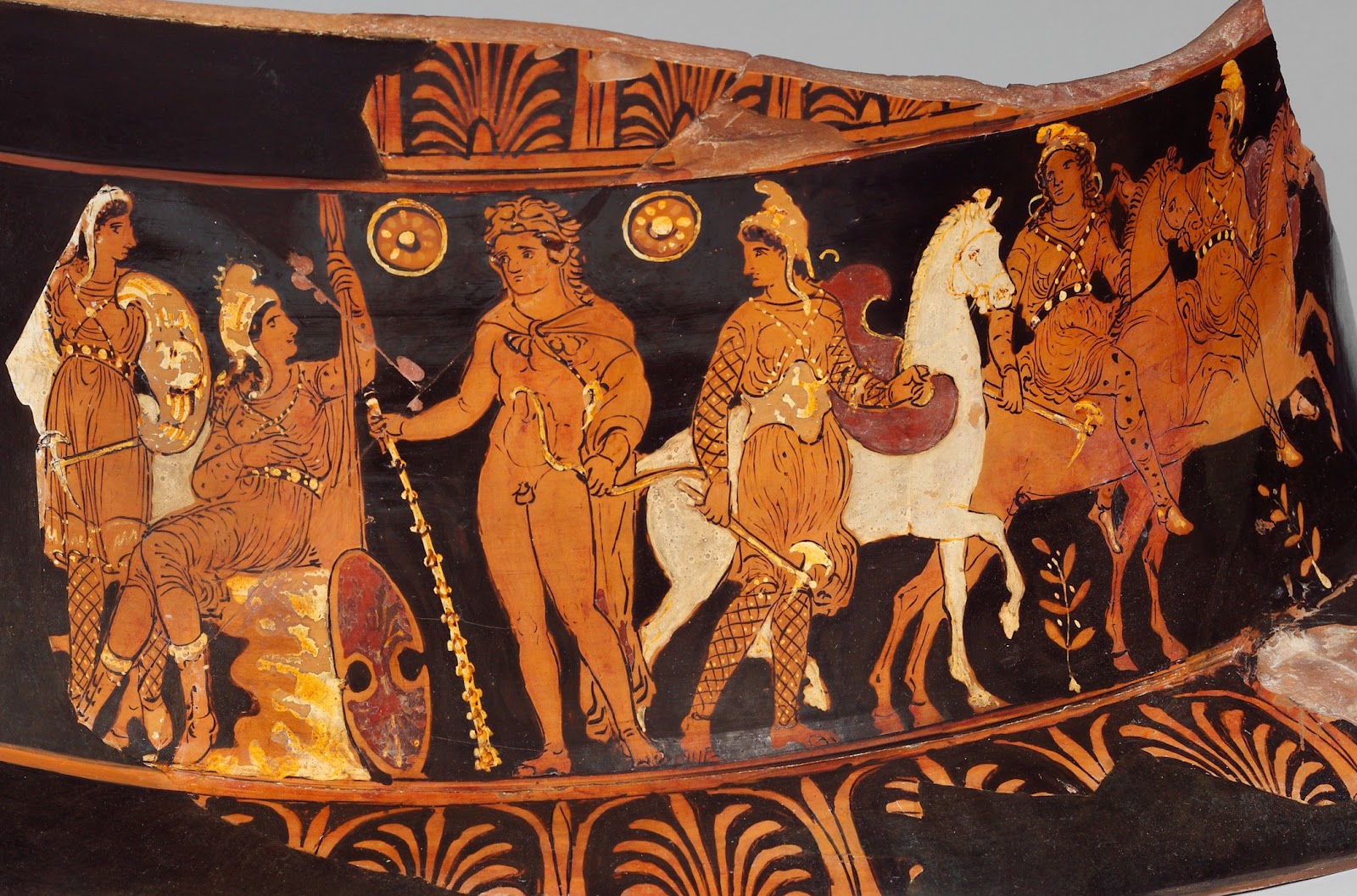
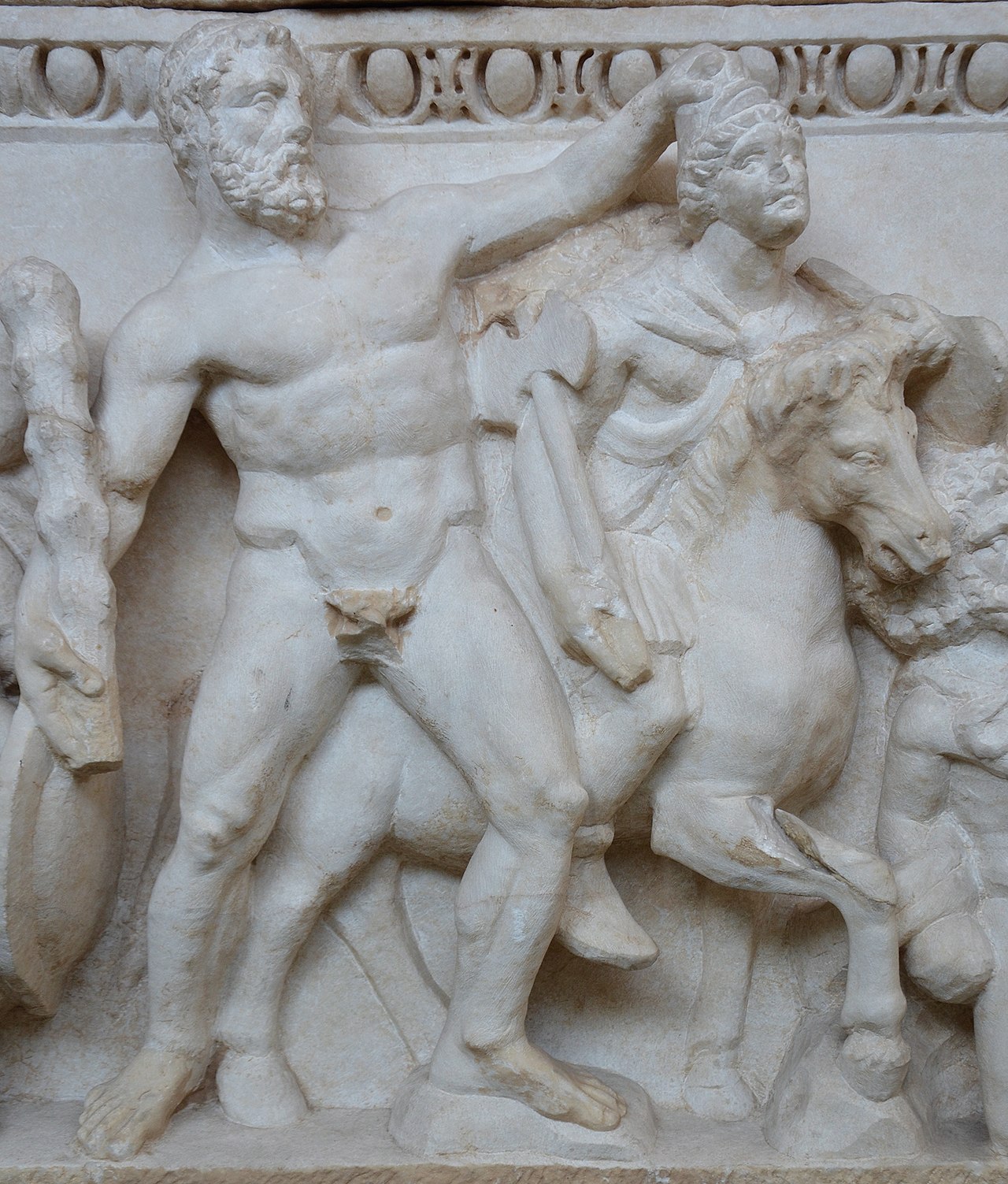
Heracles & Hippolyte's belt

 Salvete Omnes,


April 1st or April Fools Day -  what a Spring day to behold .. 

so let me invite you to the ancient Greek mythological  hero's adventure - the lion pelt clad and with armed with a bow and club Heracles, son of Alcmene and god Zeus, sailed on his quest for the belt of Hippolyte, the queen of Amazons. Accordingly the name Amazon was meant to mean ' without a breast, because the right breast was cut off, that it might not hinder the use of  bow' and javelin.


According to Apollodorus, in his 9th labor Heracles was ordered by the 'evil' Eurystheus, king of Tiryns, to fetch him the belt of Hippolyte (belt of Ares), the queen of the Amazon warrior-women from the river Thermodon [in Pontus according to Strabo]. 


Apollodorus stated that 'these warrior-women cultivated male virtues,' while Diodorus Siculus wrote in his Book II that the women of Thermodon river held the 'sovereignty in their hand and performed services of was just as did the men. Of these women one, who possessed the royal authority, was remarkable for the prowess in war and her bodily strength, and gathering together an army of women she drilled it in the use of arms and subdued in was some of the neighbouring peoples[..], and as the tide of her fortune continued favorable, she was so filled with pride that she gave herself the appellation of  Daughter of Ares.' Greek god  Ares had a belt made for the queen, known as the belt of Ares. Their capital was called Themiscyra, in the mouth of Thermodon.


Heracles, according to Apollodorus, came by ship with his companions, and having put into the harbor of Themiscyra was visited by queen Hippolyte wearing the belt. Goddess Hera, always trying to derail Heracles in his efforts, arrived in the likeness of an Amazon warrior and went up and down the horde of Amazons saying the strangers who had arrived were carrying off the queen. So the Amazons in arms charged astride their horses down the harbor. But when Heracles saw them in arms, he suspected treachery, and killing Hippolyte stripped her of her belt. And after fighting the rest[of the Amazon host] he sailed awaya dna touched at Troy.'


Diodorus, Book II, 4-16.,  gives a detailed description of the battle between Heracles and the Amazons. 


enjoy

valete

Sunday, August 13, 2023

Mazeppa's Ride - Byron

 Salvete Omnes,


While in college I took an advance class in English late XVIII and XIX century literature - from William Blake to Kipling et al. 

Among many poems, novels, and other works of literature we studied there were poems of  George  Gordon, Lord Byron.

Byron wrote a long poem somewhat based on the life of  Ivan (John) Mazepa-Kolodynski, a nobleman of Kurcz coat of arms, and a real political leader, a hetman, of the Zaporozhian Cossacks of the so called 'Left-Bank Ukraine(semi-independent Russian territory on the left bank of the Dnieper River taken from Polish-Lithuanian Commonwealth during the long war of 1653-1667). At first strong ally of the Russian tsar and Polish-Saxon king Augustus hetman Mazepa and his Cossacks switched sides, from Russian-Saxon to  Charles XII, King of Sweden,  during the Great Northern War. But upon the defeat of the Swedish-allied forces at Poltava (allied - Swedish-Polish-Cossack army was defeated  by tsar Piotr  I(Peter) of Russia) he withdrew his remaining Cossack forces into the Ottoman territory, where being a refugee from his land Cossack hetman Mazepa died at Bendery in the fall of 1709.
Byron took the story of the ride from some French publications, perhaps from Voltaire's History of Charles XII, King of Sweden, while Voltaire must have taken it from perhaps some French courtier who had been a courtier or soldier of our king John III Sobieski, and via Polish court had been acquainted with the Mazepa's tragic amorous story. The original story seem to have been  first described by Polish memoirist Jan Ch. Pasek in his memoir. 
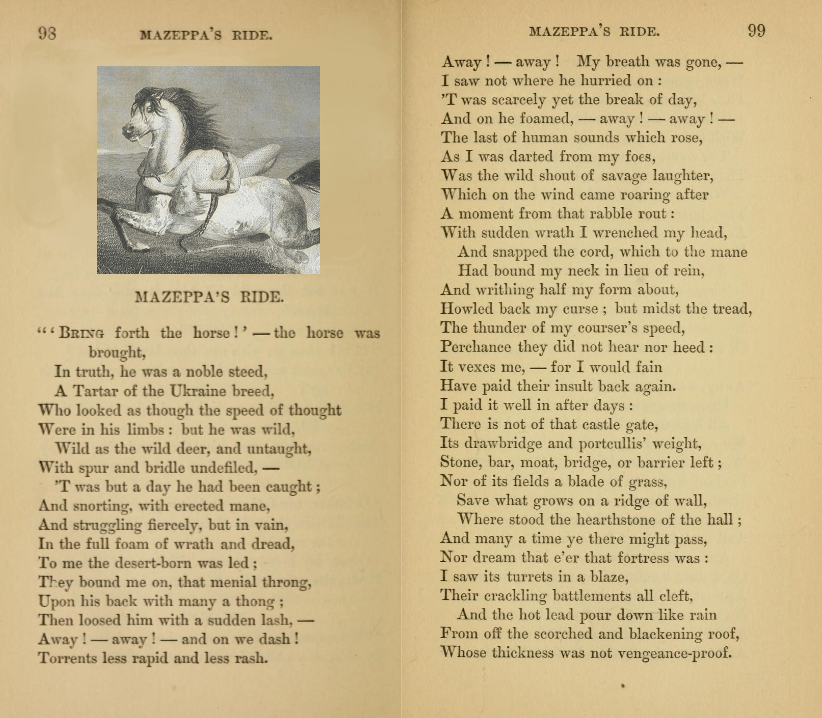
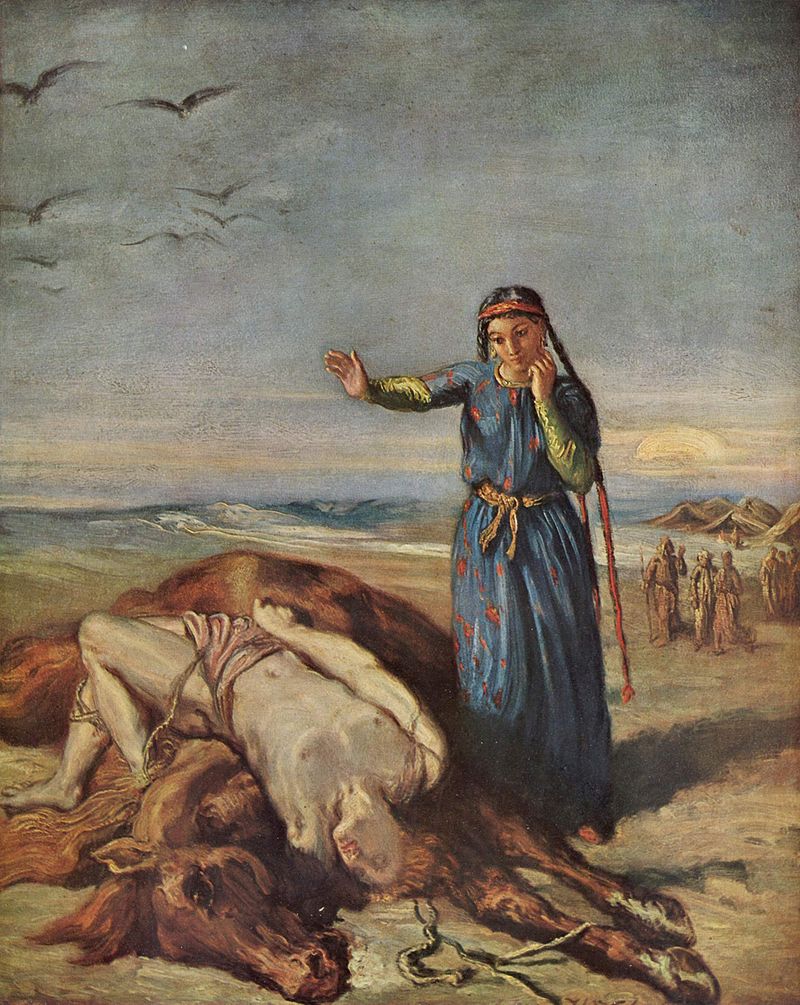
The important aspect of the epic poem is the famous Mazeppa's ride -  on the back of the 'Tatar noble steed.' - as we call it a bachmat.


  the Mazepp'a Ride via Byron's own verse and artwork that came after the publication of the poem


one day soon we may read about the historic Mazepa's  ride as our XVII century Polish memoirist Jan Ch. Pasek described it.

Valete

Sunday, June 4, 2017

Eugène Delacroix - horses and warriors of Greek War

Salvete omnes,
[pretty good Latin-English translator on line]
another Sunni Islamic jihadists terrorist attack in the United Kingdom - pacem aeternam to all victims!

I chose to share (from Wiki Commons) some paintings by the famous Delacroix, they are both violent and beautiful and reflect somewhat on our turbulent times.

 In these paintings artist tried to depict  the Greek War of Independence fought by the radical Greeks against the Ottoman Empire.

This conflict begun the unraveling of the Ottoman Empire in the Balkans - Serbs, Bulgars etc fought their own wars for independence.

The Greek came out in some rather strange way from this struggle, their country was very small, with the majority of the ethnic Greeks and traditional Greek territories outside of this new state. The state - a kingdom-    in fact was  a very unfunny mix of then-superpowers' agenda (mostly British), for it was in fact a strong check on ethnic and nationalistic designs, with the type of government established and their Bavarian ruling dynast imposed on them [sort of like at the present, where the state is bankrupt and the Greek people are run the German banks and Communist 'traitors' - I guess they gave up their liberty with leaving drachma by taking the euro currency] .
Eventually the Greek kingdom failed to liberate their proper Greek lands in Asia Minor and eastern Thrace during the subsequent wars with the Ottomans and in consequence suffered expulsion of the entire Greek population from Anatolia (Western Asia) and Constantinople thus ending 3000 years of Greek Anatolian culture.
Great Britain was the champion of the Ottoman status quo through out the XIX and early XX century (up to World War I) then supported some Greek aspirations if they enter the war on behalf of the allies. However, the British were not willing to allow the Greeks to take all the Greek-populated lands in Western Asia - the Megali Idea - but limiting the Greek take on the Ottoman territories only to Smyrna [present Izmir] and really as a counterbalance to the Italian (and French) designs on the Ottoman lands - which lead to the Greco-Turkish War in 1919. Eventually the new leader of the Turkish state Mustafa Kemal Pasha outwitted the British in this game, mostly by using the Bolshevik scare, and the British did not materially side with their Greek proxy in the persecution of the war against the Nationalistic Turks. - this thesis  describes the Greco-British relations up to the end of the Greco-Turkish war in 1922 and subsequent peace settlement in 1923.

Nota bene, it was Great Britain that gave us Poles the infamous Curzon Line, that in 1939 and again in 143-45 provided the excuse and allowed Stalin to take away from us our beloved Kresy with cities like Lwów (Lviv) etc). And it was Great Britain that did not allow for the return of city of Gdansk (creation go the strange Free City) and most of former land taken by Prussia in 1772 etc to the newly reestablished Poland in 1919 - it was only the show of arms: via the Greater Poland and Silesian uprisings that brought these parts of Poland back to the Motherland.

ad rem,
Delacroix  was self-interested in his creations on the subject of the Ottoman-Greek struggles, for he was trying to make a name for himself in the Parisian art circles, especially with the painting tittled The Massacre at Chios. He did succeed and is considered as one of the masters nowadays.

The native costumes of the combatants are very similar, turbans are the sign of the Ottomans, while the horsetack is wholly Ottoman. 

Greek horsemen
Greek horseman and an Ottoman Turk

combat between a giaour [infidel, probably Greek] and Ottoman pasha


Greek (Souliote) soldiers dancing


and this image is powerful and very violent
Arabian horses fighting inside the stable
a young Turkish horseman

ps
While I lived in Brooklyn, I used to frequent the Kesso Greek yogurt manufacture and store in Queens,  the wonderful owners were of rather very advanced age  and themselves had been refugees from the Turkish pogroms in Istambul in 1950s. I used to listen to their quite wonderful stories about life  in the ancient city in the 1940s while eating various yogurts (more fat and different 'baking' times) and delicious home made Greek dishes.