Sunday, September 16, 2018

Die Blume des Kampfes - mounted fencing

Salvete Omnes,

 from Wiktenauer project - Die Blume des Kampfes (Cod.5278) German (Holy German Empire ) circa  AD 1420 includes mounted fencing plates.
Just sharing them with you these plates. for inspiration study and enjoyment:


Valete!

Saturday, September 15, 2018

Morisco Bits North Africa - MET

Salvete Omnes,
North African morisco bits from the MET:
Tuareg


 Maghreban


Valete!

Morisco bit from Ottoman Empire - MET

Salvete Omnes,
 more ring bits today - Ottoman Empire morisco bit - MET collection


Valete!

Morisco alias ring bit from New Spain - MET

Salvete Omnes,
riding aids from history:
a morisco bit aka ring bit from New Spain (today Mexico and southwestern US) XVIII century - Metropolitan Museum of Arts collection.


Valete

Friday, September 14, 2018

Jan Chryzostom Pasek - szwadron

Salvete omnes,
[in Polish]
Na blogu raczej nie sięgałem do Paska, ale dzisiejszym wpisem otwieram sobie drzwi do świata widzianego w pamietnikach pana Paska.
 Ad rem, imc pan Jan Chryzostom Pasek,  wciąż sławny [1]  i  niezwykły pamiętnikarz epoki II polowy XVII wieku, obywatel i zolnierz  Rzeczpospolitej Obojga Narodów, którego pamiętniki oprócz ogromnej wartości literackiej i historycznej są także gotowym scenariuszem na szereg filmów i seriali filmowych, komiksów czy opowieści graficznych czy nawet gier cyfrowych - ale o tych głucho i cicho wszędzie, niestety.

 I przywołany dzisiaj Pan Pasek napisał był o tytułowym  szwadronie w kwestii husarii circa AD 1660, kiedy to dywizja Stefana Czarnieckiego z wojskami Wielkiego Księstwa Moskiewskiego i Kozakami ukraińskimi nad rzeka Basia się uganiała.

Skąd wpadłem an przywołanie wpisu pana Paska, otóż czytając dr Radka Sikory jedyna jak do tej pory na rynku polskim prace o husarii pod Wiedniem AD 1683 pochyliłem się nieco bardziej  nad fragmentem o szykach husarii a zwłaszcza nad akapitami dotyczącymi taktycznej jednostki jaka wydaje się był 'szwadron' w bitwie pod Wiedniem (strona 14-141) te 335 lat temu.
 Tamże autor wnioskuje, ze chorągiew husarska tworzyła z dwoma chorągwiami pancernymi jednostkę taktyczna (PHP) zwana w przekazach źródłowych z epoki 'szwadronem', 'szkwadronem' czy 'skwadronem' (ta nazwa już wcześniej była znana, bo od początku XVII w. - nota bene szwadron epoki Sobieskiego to po francusku  le escadron np z przekazu Dupont'a Memoires, strona 138).

O związku taktycznym husarsko-pancernym zwanym szwadronem dr Radek Sikora pisze dużo wcześniej bo już w swej pracy doktorskiej, w rozdziale o szykach husarii. Pisze o szwadronie także w innej swej książce o niezwykłych szarżach i bitwach husarii.

Wróćmy do naszego towarzysza pancernego dywizji Czarnieckiego AD 1660, ergo Jan Pasek pisze o husarii i szwadronach - (edycja Wladyslawa Czaplinskiego, Warszawa 1979, strona 159) co nastepuje:
bitwa nad rzeka Basia:
-- ''Rok 1660[...] ale ze res non patiebatur moram*[...] Uszykowano tedy wojsko tak, jak i przeciw Chowanskiemu; ale juz choragwie husarskie, których było dziewięć, rozdzielano - kozda na trzy szwadrony, a za kozdym szwadronem pancerna chorągiew. Bylo tedy wojsko tak ozdobne, ze się zdało, ze jest husaryjej ze sześc tysięcy. Stanelo tedy w szyku wojsko; my [Pasek w choragwi] z Woynillowiczem na prawe skrzydło...'' --
 Kwestia czy użyta przez Paska nazwa odpowiada użyciu tejze pisowni i nazwy juz w  1660 roku czy tez była bliższa okresowi pisania Pamiętników przez imć pana Paska czyli epoce lat 1690tych.

W każdym razie chciałbym zaznaczyć zaistnienie szwadron jako jednostki taktycznej stworzonej zdaje się doraźnie bo głownie z powodu braku wystarczającej liczby kopijników (husarzy) w armii polskiej w czasie trwającej kampanii wojennej, i później rozwijanej w ciągu kolejnych kampanii wojennych , zwłaszcza epoki Jana Sobieskiego,  jako cześć historii polskiej sztuki wojennej i historii jazdy polskiej.

Ilustracja to kombinacja fragmentów  ryciny Abrahama van Booth'a circa 1628, planuje zrobić szereg ilustracji pokazujących szyki chorągwi husarskich i pancernych.

Valete.

*-''rzecz nie cierpiala zwloki'' [lacina]

[1] (bo czasy mamy ciekawe, i możne być uznanym np za staropolskiego szowinistę czy rasistę i wyrzucony z panteonu literatury staropolskiej etc)

Wednesday, September 12, 2018

Vienna 1683-2018


Salvete Omnes,
yesterday I did some reminiscing about the tragedy of 9-11 and the war that has been following  the attack ever since and that this war may last forever.

    Since the early morning, but 335 years ago, the Polish, Imperial and German states troops or the allied Christian army had been battling their way down to the plain where capital of Hapsburg empire was surrounded and had been besieged by the multiethnic Ottoman army under grand vizier Kara Mustafa.

     Islamic and Christian soldiers fought one another since the early morning, at first the infantries battling one another, but carried by their bravery and good soldiering slowly the Christian soldiers pushed their Muslim adversaries towards the Ottoman camps and thus opened way for the possibility of cavalry to charge.

It was already the afternoon and perhaps the final assault would have taken the next day,  since Jan III Sobieski had envisioned the final assault against the Ottoman lines, with the Polish cavalry leading the way, especially Polish lance-bearing cavalry, i.e. , the winged hussars armed with kopia ( perhaps 4.5-6meters long, hollowed and painted lance with equally swallow tail long pennon ).
Thus King Jan III was waiting for the moment when field was cleared for the lancer banners to probe the terrain and to attempt the charge. Sometime between 1600 and 1700 hours Jan III ordered one of his army winged hussar companies - prince Aleksander Sobieski - commanded by Zbigniew Zbierzchowski to charge the multitudes in front of the king-led right Polish Crown wing of the Christian army, this being the left wing of the Polish forces.

It was clear that Jan III wanted to know if such mounted  charge was feasible.

The 110-120 lancers and horses-strong company of heroes, in two kopia-bristling rows with red and white pennons flying, charged towards the direction of the commander-in-chief of the Ottoman army huge tent looming in the distance with many thousands of sipahi and otehr cavalrymen of the Ottoman main lines; in front of the charging winged hussars went, on his own volition, the court treasurer Andrzej Modrzewski armed and armored as a pancerni cavalryman.
Pan Modrzewski, galloping well in front of the charging banner, reached the Ottoman screening horsemen and soon was engaged by some brave Ottoman horsemen,  in short time he killed one or two with dzida and wounded some but nunc Hercules contra plures and he had been disabled with some well aimed cirit javelin and dzida blows and  died before the charging winged hussars were able to even reach join him in this uneven fight (his body was carried back to the Polish lines with his head intact as the cantering whinged hussars prevented the Ottoman cavalrymen from carrying away Modrzewski's head); having suffered  their first casualty the winged hussar banner went cantering forward and struck the Ottoman lines at a full gallop like a lightning, but was surrounded on its wings and eventually came to a standstill amidst the Ottoman units. Yet  with utmost difficulty they were able to disengage from their  Muslim foe and with some serious losses (12 companions and perhaps 25-30 retainers were killed ) the winged hussar banner was able to return  to the king proving the charge was possible.

During this charge on the left wing of the Polish Crown army, on the right wing of the Crown forces  another charge was made by a tactical cavalry  unit known as szwadron ( Castellan of Krakow Andrzej Potocki winged hussar banner with two pancerni banners- starost of Halicz Stanislaw Potocki and starost of Rzeczyca Jozef Sluszko - on its wings) led the starost of Halicz Stanislaw Potocki, this unit charged  on the right wing of the Polish army, soon seconded by the second szwadron under voivode of Krakow Szczesny Potocki (his own winged hussar banner and his own pancerni banner and another pancerni banner- Boguslaw Potocki's one). The charging cavalry suffered more losses in total than the lonely royal Sobieski banner and proved that the terrain was quite difficult on this wing of the Polish army.
Finally satisfied as to the possibility of all-out cavalry charge the commander-in-chief of the Christian allied armies and king of Polish-Lithuanian Commonwealth ordered all winged hussar and pancerni companies grouped into szwadron tactical units to charge the Muslim lines. The many thousands of riders of the allied cavalry companies followed in tow.
The rest is history...
Hail to the Victors!
Vae Victis!


..


Valete

Sunday, September 9, 2018

Robert Lee and a Young Soldier

Salvete Omnes,
we still have some summer left -
sunny Texas used to display a beautiful sculpture in one of the Dallas' parks. Sculpted by one of the most talented American sculptors Alexander Phimister Proctor during the 1930s and unveiled by the US President (4 times ) Franklin D. Roosevelt stood for some 81 years in Dallas.
Beautiful horses and horsemanship rendered, would love to see Proctor's wax sketches and drawings done for the creation of this bronze monument.
It has been removed last year - Woe to Arts  in the US...


all about the sculpture & photograph
Valete


Saturday, September 8, 2018

Professor Jozef Wolski (1910-2008)

Salvete Omnes,
today a quick entry. It has been a while since I visited the ancient Iran.
Hence I would like to take bring to your attention the person and scholarship of professor Jozef W. Wolski, Polish scholar and gentleman, whose life and work has been nicely brought together in this article by professor Marek Olbrycht (another version from Iranica).
You can download the Wolski's doctoral thesis - Arsaces I of Parthia - , in Polish, from the Wielkopolska Biblioteka Cyfrowa - 1937 and 1938 issues of Quarterly EOS.
I am including in this post my sketch of the Parthian kontophoros or heavy lancer hunting a lion, a copy from a Babylonian ceramic tile (held at the British Museum).
lion hunt

Valete!

Thursday, September 6, 2018

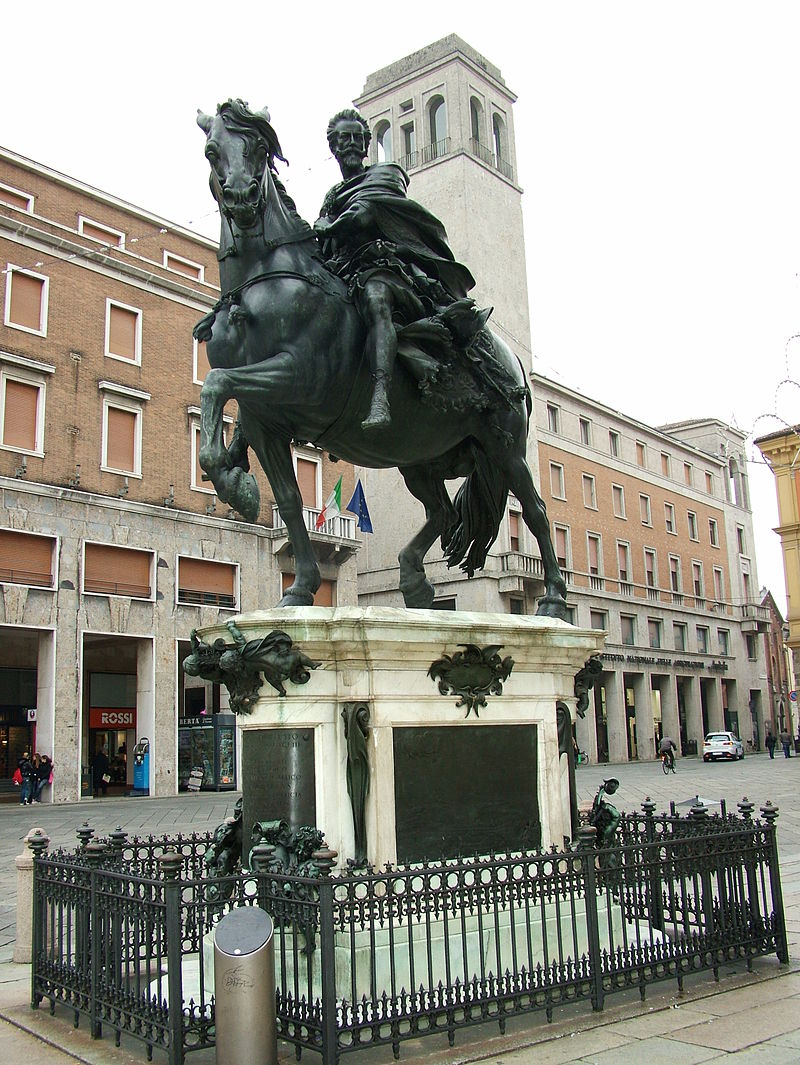
Francesco Mochi - Piacenza equestrian sculpture II


Salvete Omnes,
continuing on the theme of the Frencesco Mochi the second equestrian sculpture from Piacenza
Alessandro Franesse, duke de Parma and Piacenza et al, father of Ranuccio I, done circa AD 1625:


some portraits of duke Alessandro, including his fabulous portraits in armor


Valete!